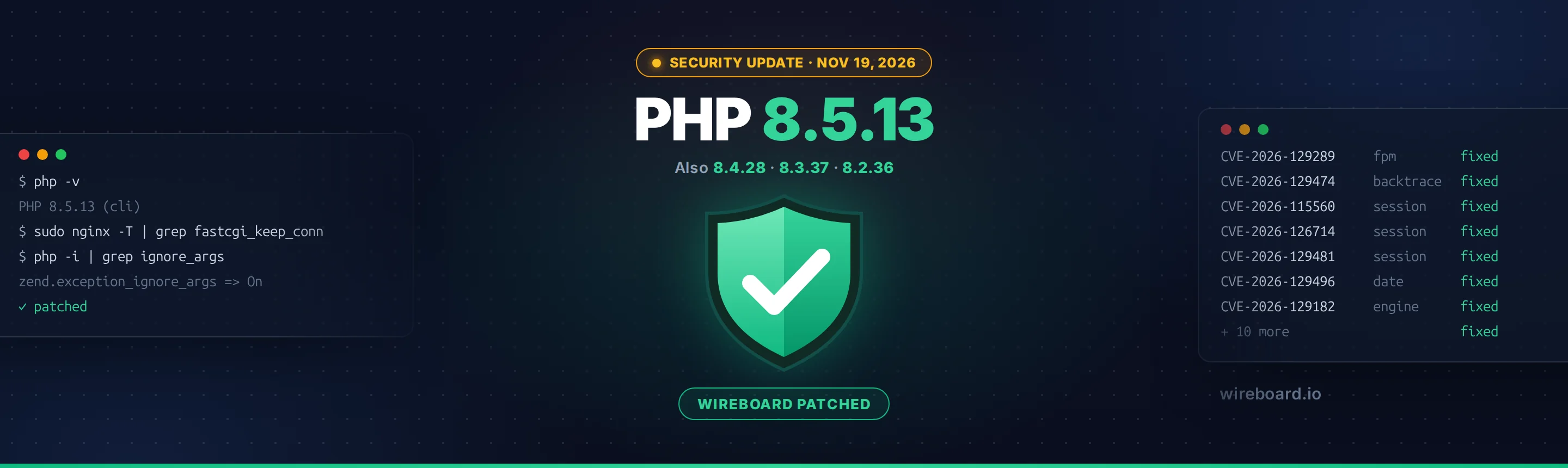
Today, November 19, 2026, PHP released security updates for every supported version: 8.5.13, 8.4.28, 8.3.37 and 8.2.36. They fix 17 vulnerabilities, seven of them rated critical. It's the second critical PHP release in a month, after the PHP2Shell fixes of October 21.
This time, the critical flaws depend on how PHP is set up. The PHP team says they "require either non-default configuration or uncommon setups". Some of those setups are more common than they sound, though: we found two of them in our own configuration.
WireBoard has already been updated. You don't need to do anything for your WireBoard account or tracking script.
If your own website or app runs on PHP, please read on, check the two settings below and update.
TL;DR
Update to | Severity | |
|---|---|---|
PHP | 8.5.13, 8.4.28, 8.3.37 or 8.2.36 (or 8.6.0, also released today), or your vendor's patched package | Critical (CVSS 9.2) in specific setups, up to remote code execution |
Using WordPress, Magento, Drupal, Laravel, Symfony or another PHP app? You're running PHP. Update.
On shared or managed hosting? Your host applies the fix. Check that they have.
Check two settings today: whether your web server reuses connections to PHP-FPM (nginx
fastcgi_keep_conn, Apacheenablereuse) and, on PHP 8.5, whetherzend.exception_ignore_argsis on.After updating, restart PHP-FPM or Apache, otherwise the old version keeps running.
On PHP 8.1 or older, you won't get a fix. PHP 8.2 gets security fixes only until December 31, 2026.
What happened
The seven critical flaws
All seven are rated 9.2 on the CVSS v4 scale. Each one needs a specific setup to be exploitable:
CVE | What it is | Your site is exposed if |
|---|---|---|
CVE-2026-129289 | PHP-FPM request smuggling | Your web server keeps the connection to PHP-FPM open between requests (nginx |
CVE-2026-129474 | Use-after-free in error backtraces (PHP 8.5 only) |
|
CVE-2026-115560 | Session serializer mismatch | Session upload progress is on (it was on by default until today) and apps, pools or jobs sharing a session store use different |
CVE-2026-126714 | Partially overwritten session files | PHP's built-in file sessions are used, an attacker can influence session contents and interrupt a write. |
CVE-2026-129481 | Use-after-free after interrupted session shutdown (8.3 and later) | A fatal error happens while PHP closes a session. Not shown to run code so far. |
CVE-2026-129496 | Use-after-free in the timezone cache | PHP writes errors to a log file and logs a warning when it starts, for example about an invalid |
CVE-2026-129182 | Use-after-free after shutdown (PHP 8.5 only) | Unusual overrides of |
The PHP-FPM request smuggling flaw is the one to close first: it's the most direct route to running code, and its key condition is a performance setting found in tuned configurations, including some ready-made Docker images.
For the session flaws, code execution also needs a suitable "gadget" class in the application. The advisory demonstrates it with Guzzle and Monolog, two libraries found in a large share of PHP projects.
The other fixes
High: a privilege escalation in PHP-FPM for someone who can already run code (CVE-2026-129291, needs
catch_workers_output), data sent unencrypted when a URL is writtenHTTPS://in capitals (CVE-2026-128064), a denial of service through malicious HTTP responses (CVE-2026-127960), and a Phar signature bypass (CVE-2026-128090).Medium: cross-site scripting on the PHP-FPM status page, PHP-CGI, two SOAP flaws, DOM serialization and URI handling.
As of November 19, none of these flaws has been reported as exploited. The advisories are detailed, though, so expect attacks to follow.
One behavior change
The fix turns session upload progress off by default. If your site shows upload progress bars through PHP's own session feature (rare: most sites track uploads in JavaScript), turn it back on explicitly with session.upload_progress.enabled = 1, and make sure everything sharing your session storage uses the same session.serialize_handler.
What we did
We updated WireBoard to PHP 8.5.13 today and reviewed our setup against every advisory:
Two of the critical flaws matched our configuration. Our web server reused its connections to PHP-FPM, and our PHP used the built-in default for
zend.exception_ignore_args. We turned connection reuse off and set the setting to its production value, on top of the update.We also turned off session upload progress, which we never used.
The other critical flaws didn't apply: WireBoard doesn't use PHP's built-in sessions, doesn't write PHP errors to a log file, and doesn't pass
PHP_VALUEsettings.
The rollout caused no downtime, and nothing changes in how you use WireBoard.
Are you affected?
You need to act if your website, app or server uses PHP, directly or through a CMS or framework such as WordPress, WooCommerce, Magento, Drupal, Joomla, Laravel or Symfony.
Check especially carefully if:
You run nginx in front of PHP-FPM and tuned it for performance, or use Apache with
mod_proxy_fcgi.You run PHP in Docker and never copied
php.ini-productioninto place.You're on PHP 8.5.
Not sure? Ask your developer or hosting provider: "Does our site run on PHP, and has it been updated to the November 19 security release?"
How to check
Your PHP version
The version your web server uses is the one that matters. php -v in a terminal shows the command-line PHP, which may differ.
Create a file called
info.phpin your site's web root containing<?php phpinfo();Open it in your browser and check the PHP Version at the top. Look up
zend.exception_ignore_argsandsession.upload_progress.enabledon the same page, and check Loaded Configuration File: "(none)" means PHP runs on its built-in defaults.Delete the file immediately afterwards: it exposes your full server configuration.
You're patched with 8.5.13, 8.4.28, 8.3.37, 8.2.36 or 8.6.0. Linux distributions often backport the fix without changing the version number: in that case, check the package changelog for the CVE IDs (see below).
Does your web server reuse connections to PHP?
# nginx
sudo nginx -T 2>/dev/null | grep -n fastcgi_keep_conn

# Apache with mod_proxy_fcgi
sudo grep -rn enablereuse /etc/apache2 /etc/httpd 2>/dev/null
fastcgi_keep_conn on or enablereuse=on means you're in the setup the request smuggling flaw needs. Update first, and turn it off if you can't update today (see below).
How to update PHP
Pick the section that matches how PHP is installed on your server.
Shared or managed hosting
Your provider manages PHP and applies the fix. Check their status page or announcements, then confirm the version with phpinfo() as above.
Ubuntu / Debian
sudo apt update
# replace 8.3 with the PHP branch you use
sudo apt install --only-upgrade 'php8.3-*'

# confirm the fix is included
apt changelog php8.3-fpm | grep CVE-2026-129289
If the last command prints nothing, the fix hasn't reached your distribution yet. At the time of writing, Debian has published fixed packages for Debian 12 and 13, and Ubuntu's are still pending. Check the Debian Security Tracker or Ubuntu's CVE page, and try again later. If you use Ondřej Surý's PHP packages, update from that repository the same way.
RHEL / AlmaLinux / Rocky Linux
sudo dnf upgrade 'php*'

# confirm the fix is included
rpm -q --changelog php-fpm | grep CVE-2026-129289
If you use the Remi repository, update from there.
Docker
The official php images were rebuilt on November 19 with all four patched versions. Pulling a new image doesn't update containers that are already running. Pull, rebuild and recreate:
docker compose build --pull
docker compose up -d
For extra certainty, pin the patched version in your Dockerfile (for example FROM php:8.3.37-fpm). And while you're in there: the official images load no php.ini at all, so PHP runs on its built-in defaults. The image's documentation recommends the production settings:
RUN cp "$PHP_INI_DIR/php.ini-production" "$PHP_INI_DIR/php.ini"
This also changes other settings (errors are no longer displayed, for example), so test it before you deploy.
Built from source or Windows
Download the patched release from php.net/downloads.
Then restart PHP
Running processes keep using the old PHP until they restart:
# PHP-FPM (Debian/Ubuntu; replace 8.3 with your branch)
sudo systemctl restart php8.3-fpm

# PHP-FPM (RHEL family)
sudo systemctl restart php-fpm

# Apache with mod_php
sudo systemctl restart apache2   # or httpd on RHEL
Then check phpinfo() again to confirm the new version is live.
If you can't update right away
These steps close the known attack paths until you can update. They don't replace the update.
Stop reusing connections to PHP-FPM (CVE-2026-129289). In nginx, remove fastcgi_keep_conn on;. In Apache, remove enablereuse=on from your ProxyPass or ProxySet lines. Then reload the web server.
Set two PHP settings in php.ini or your PHP-FPM pool configuration, not with ini_set() or .user.ini:
zend.exception_ignore_args = On
session.upload_progress.enabled = 0
The first closes the PHP 8.5 backtrace flaw (CVE-2026-129474). The second closes the upload progress path of the session flaws (CVE-2026-115560 and CVE-2026-126714). Restart PHP-FPM or Apache afterwards.
Fix warnings PHP logs when it starts (CVE-2026-129496): look at the top of your PHP error log after a restart and fix any startup warning, such as an invalid date.timezone or a deprecated setting.
If you're on an end-of-life version
Official fixes only ship for PHP 8.2, 8.3, 8.4, 8.5 and 8.6. PHP 8.1 and older get no official release. Some Linux distributions and paid long-term-support vendors backport fixes, so check with yours; otherwise, upgrading to a supported branch is the safe path.
PHP 8.2 reaches its end of life on December 31, 2026, six weeks from now. If you're on 8.2, this is a good moment to plan the move to 8.4 or 8.5.
Learn more
Official advisories
PHP 8 ChangeLog (all fixes, by version)
PHP advisory GHSA-qc49-hpvq-g2w6 (CVE-2026-129289, PHP-FPM request smuggling)
PHP advisory GHSA-8mjj-2r7p-4hg2 (CVE-2026-129474, backtraces)
PHP advisory GHSA-658j-r8rw-q6mx (CVE-2026-115560, sessions)
Helpful guides
Aikido: PHP critical security release, 19 November (plain-language overview)
Upwind: PHP critical vulnerabilities, affected versions and mitigations (all seven critical flaws, one by one)
Docker's official PHP image: configuration (how to use
php.ini-production)