


Which should you pick: WireBoard or Matomo?
Matomo and WireBoard are both web analytics platforms positioned as alternatives to Google Analytics. Both are EU-friendly, both let you escape the data-leaves-Europe problem, and both go far past pageviews. Past those overlaps, they were built on different theories of what an analytics product should be, and that is what makes the choice interesting.
Pick Matomo if you need a tool that runs on servers your own infrastructure team controls, if heatmaps, session recordings, A/B testing, or form analytics belong in your weekly review, if you want a deep marketplace of plugins to extend the platform piece by piece, or if your procurement process specifically requires the ISO 27001 paperwork Matomo Cloud publishes.
Pick WireBoard if you watch your traffic live during launches, ad runs, and Google update days, if you operate several sites and want them rolled into one streaming view, if you keep arranging your dashboard around the way you actually work, if you want every analytics feature included on every paid tier without picking from a menu, or if SERP volatility and Google update tracking belong on the same screen as your traffic.
Below: the side-by-side scoreboard, the three product decisions that pull the two tools apart, where Matomo is the stronger pick today, where WireBoard is, the pricing math, and how to compare them side by side on your own site.
At a glance
| WireBoard | Matomo | |
|---|---|---|
| Real-time | Streaming live widgets, real-time funnels, live event feed | Visits in Real-time and Real-time Map widgets, 5-second auto-refresh |
| Hosting model | Managed only, EU in-house pipeline | Cloud (Frankfurt, AWS Europe) or self-host (your servers) |
| Open source | No | Yes (GPL v3 core), premium plugins under a separate EULA |
| Heatmaps and session recording | Not offered | Premium plugin, allowance per Cloud tier |
| A/B testing | Measure variants via custom events; no native experiment engine | Premium plugin (variant assignment, lift, experiment UI) |
| Form analytics | Not offered | Premium plugin |
| Multi-site live aggregation | Yes, in a single widget, streaming | Roll-Up Reporting (included on Cloud Business; paid plugin On-Premise), aggregated reports |
| SEO suite (SERP volatility, Google updates, holiday overlay) | Included on every plan | Not offered |
| Annotations layer on time-axis charts | Four built-in layers + per-user notes | Annotations included |
| Dashboards | 60+ widgets, drag-and-drop, multiple per site, populated default template | Drag-and-drop widgets, multiple dashboards per user |
| Funnels | Every plan, real-time, flexible order | Included on Cloud Business; paid yearly plugin on On-Premise |
| Custom events | Every plan, including free | Included on every plan |
| Free plan | Permanent, every feature, 50k pageviews/mo | 21-day Cloud trial, then paid; or free On-Premise (server cost on you) |
| Data retention | 3 years on every paid plan | 24 months raw on Cloud Business, aggregated reports kept beyond |
| Cookieless mode | Optional toggle, off by default for accuracy | Cookieless tracking option, CNIL-recognised in France |
| EU data residency | Yes, full pipeline in-house, operated by SwissOps Ltd. | Cloud hosted on AWS Europe (Frankfurt, Germany) |
| Public API | REST on every plan including Free (30-day history cap on Free); Live (Server-Sent Events) on every paid plan. Official JS + Python SDKs and an MCP server for LLM agents | Reporting API (HTTP) on every plan (Cloud and On-Premise); no official MCP server |
Two analytics products built on opposite theories
Most analytics comparison posts stop at "both are GA4 alternatives," which is true and not very useful. The interesting comparison sits one layer deeper.
Matomo is the older theory. It launched in 2007 (originally as Piwik), open-sourced its core under GPL v3, and grew into a marketplace where the platform is extended one plugin at a time. Heatmaps, session recordings, A/B testing, form analytics, funnels, users-flow, cohorts, BigQuery export, SAML SSO: each is a separate paid plugin on the On-Premise side and an allowance on the Cloud side. The product is a base plus a menu.
WireBoard is the opposite theory. The base product is the whole product. Streaming live widgets, real-time funnels, custom events, goals with revenue, multi-site live aggregation, SERP volatility tracking, the annotation layer: every one of those features is on every paid tier, including the permanent Free Plan. There is no marketplace because there is nothing to unbundle. We chose this because the dashboard a buyer needs on day one is not the dashboard a buyer needs on day ninety, and we did not want to make customers shop their own product back to themselves.
Neither theory is wrong. They produce different products, and they fit different buyers. The next three sections walk through where the theories show up in practice.
Three decisions that actually pull WireBoard and Matomo apart
1. A marketplace of plugins, or every feature in one box?
This is the spine of the comparison. Matomo's premium feature set lives in the marketplace. On the On-Premise side, each plugin is a yearly subscription: Heatmap and Session Recording starts at €219/year, A/B Testing at €219/year, Form Analytics at €169/year, Funnels at €193/year, Users Flow at €94/year, Custom Reports at €219/year, Roll-Up Reporting at €219/year, SAML SSO at €549/year. Many of those are bundled into the Premium Bundle at a discount. On Cloud, several premium features ship with the Business plan but are bounded by per-tier monthly allowances (heatmap pageviews and session recordings are capped per tier).
WireBoard is the inverse. Every feature on the features page is on every paid tier. The Free Plan ships with the same feature surface as the Pro Plus tier, with retention and quota differences but no feature gates. There are no plugins to buy and no allowances to manage.
The trade-off is real and goes both ways. Matomo's marketplace model lets a small site pay for only what it uses (a heatmap on the checkout page, nothing else), and lets a large site buy depth WireBoard does not ship at any price (session recording, A/B testing, form analytics). WireBoard's bundled model lets a buyer at any size land on a fully populated dashboard on day one, with no menu to navigate and no feature unlock to schedule. Pick the one that matches how your team thinks about analytics spend.
2. Real-time as a five-second auto-refresh, or as streaming live?
Matomo's real-time reports are well-loved. The Visits in Real-time widget refreshes every five seconds and fades new visits in at the top of the list. The Real-time Visitor World Map refreshes on the same five-second cadence. The Visits Log report updates when you reload it. That cadence is a deliberate choice and it is fast enough to feel live for most workflows.
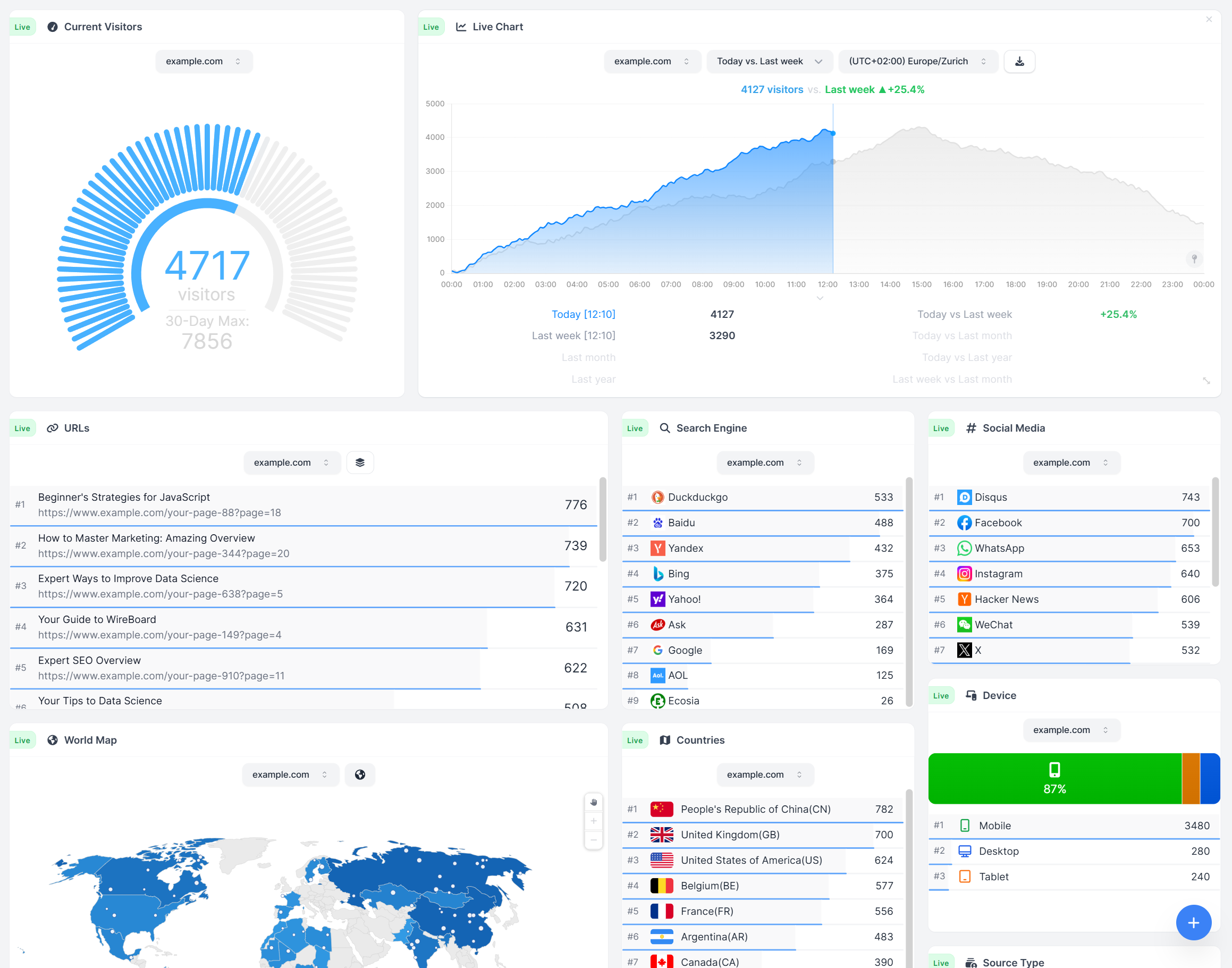
WireBoard's live widgets stream. The two leads on the features page are a live count of concurrent visitors right now and a live view of which pages they are reading. Behind those: the world map, traffic sources, device breakdown, real-time funnels, and the rest of the 20+ live widgets, all updating instantly as events arrive rather than on a polling cycle. Historical reports (date-range stats, period-vs-period, the URL Explorer, top pages over time) work on stored data the way you would expect.
Why does the difference matter? It depends on what you do with the dashboard. If you check analytics weekly before a leadership meeting, five-second auto-refresh and streaming feel identical. If you watch traffic during a launch, sit on the dashboard while a Google update rolls out, or run a flash sale, the gap stops being academic. The five-second window is fine for "is anyone here?" The streaming surface is built for "what is happening right now, and what is changing while I watch?"
3. Self-host on your own server, or trust an EU-only managed pipeline?
Matomo gives you the choice. Matomo On-Premise is GPL v3, free to download, and runs on any host with PHP and MySQL. You pick the country, the provider, and the backup policy. Matomo Cloud is the managed version, hosted on AWS Europe in Frankfurt, ISO 27001:2022 certified. If your security team's brief says "the software runs on servers we operate," On-Premise wins outright, with the caveat that the premium feature plugins (heatmaps, session recording, A/B testing, form analytics, funnels) are paid yearly subscriptions even when the core is free.
WireBoard goes the other way deliberately. The full data path (collection, processing, storage, dashboards) is built and operated by SwissOps Ltd. on EU infrastructure. No third-party ingestion service sits between your tracker and your dashboard, no part of the pipeline lives outside Europe, and we do not offer a self-host edition. That is how we ship streaming as the default rather than as a paid add-on, and how every feature lands on every plan rather than as a tier unlock. The trade-off cuts the other way too: you cannot run WireBoard on your own hardware, and you trust SwissOps Ltd. to operate the platform. If self-hosting is a non-negotiable, Matomo On-Premise is the obvious fit.
What does Matomo do better than WireBoard today?
Matomo has a deeper feature surface in several places where WireBoard does not currently compete. The honest list, sourced to their docs and marketplace:
Self-hosting under GPL v3. Already covered. Real, structural advantage if your stack policy requires it.
Heatmaps and session recording. Matomo's Heatmap and Session Recording plugin is a real depth feature WireBoard does not ship. If you debug stuck visitors by replaying their session, or you optimise a landing page by watching where visitors hover and scroll, Matomo's offering is the right shape and WireBoard does not have an equivalent on the roadmap.
A/B testing and form analytics. Two more premium plugins (A/B Testing, Form Analytics) that buyers from a CRO background often expect to find inside their analytics tool. With WireBoard's custom events you can still measure your own A/B tests (track which variant a visitor saw, compare conversions per variant in the dashboard), but the experiment-running layer (variant assignment, statistical lift, experiment UI) lives in Matomo's plugin and not in WireBoard. Form Analytics has no measurement-only workaround: field-level interactions, hesitations, and drop-off points need the dedicated tracker Matomo ships. If those workflows live in your analytics tool today, Matomo's marketplace covers them end-to-end.
Plugin marketplace breadth. Beyond the headline features, Matomo's Plugins Marketplace carries hundreds of community and premium extensions for cohort analysis, multi-channel attribution, crash analytics, search-engine keywords performance, white-label branding, and more. WireBoard does not currently expose a plugin surface; the product is what we ship.
A larger ecosystem and partner network. Matomo has been in market since 2007 (as Piwik). The downstream effect: a long tail of forum threads, agency expertise, hosting recipes, integration plugins, and certified consultants. If "size of the public community and partner network" is a tiebreaker on your shortlist, Matomo is the larger one.
ISO 27001:2022 on Cloud. Matomo Cloud publishes an ISO 27001:2022 certification, which procurement teams in regulated sectors (finance, public sector, healthcare-adjacent) often require as a checkbox.
CNIL-recognised cookie-free analytics for France. Matomo's own documentation positions its cookie-free configuration as eligible for the French CNIL's exemption from tracking-consent requirements, provided the deployment matches CNIL's recommendations. If France-specific regulator alignment is on your buying checklist, that positioning is worth weighing (and worth verifying with your own legal team for your specific configuration).
Six advantages, sourced to docs and pricing pages, not to marketing copy.
What does WireBoard ship that Matomo's plugin marketplace doesn't include?
The inverse list, sourced to what is shipping in each product:
Streaming live widgets, not a five-second poll. Two leads: a real-time count of concurrent visitors on the site this second, and a live view of the pages they are currently reading. The supporting cast (world map, traffic sources, device breakdown, real-time funnels, the remaining 20+ live widgets) updates as hits land rather than on a polling cycle. Reports are a separate surface and work on stored data.
Live aggregation across your portfolio in one widget. Point WireBoard's multi-site widget at any selection of your sites and watch the aggregated live traffic stream in. Matomo offers Roll-Up Reporting on Cloud Business and as a premium plugin On-Premise; WireBoard's multi-site is included on every paid tier and streams live rather than aggregating into reports.
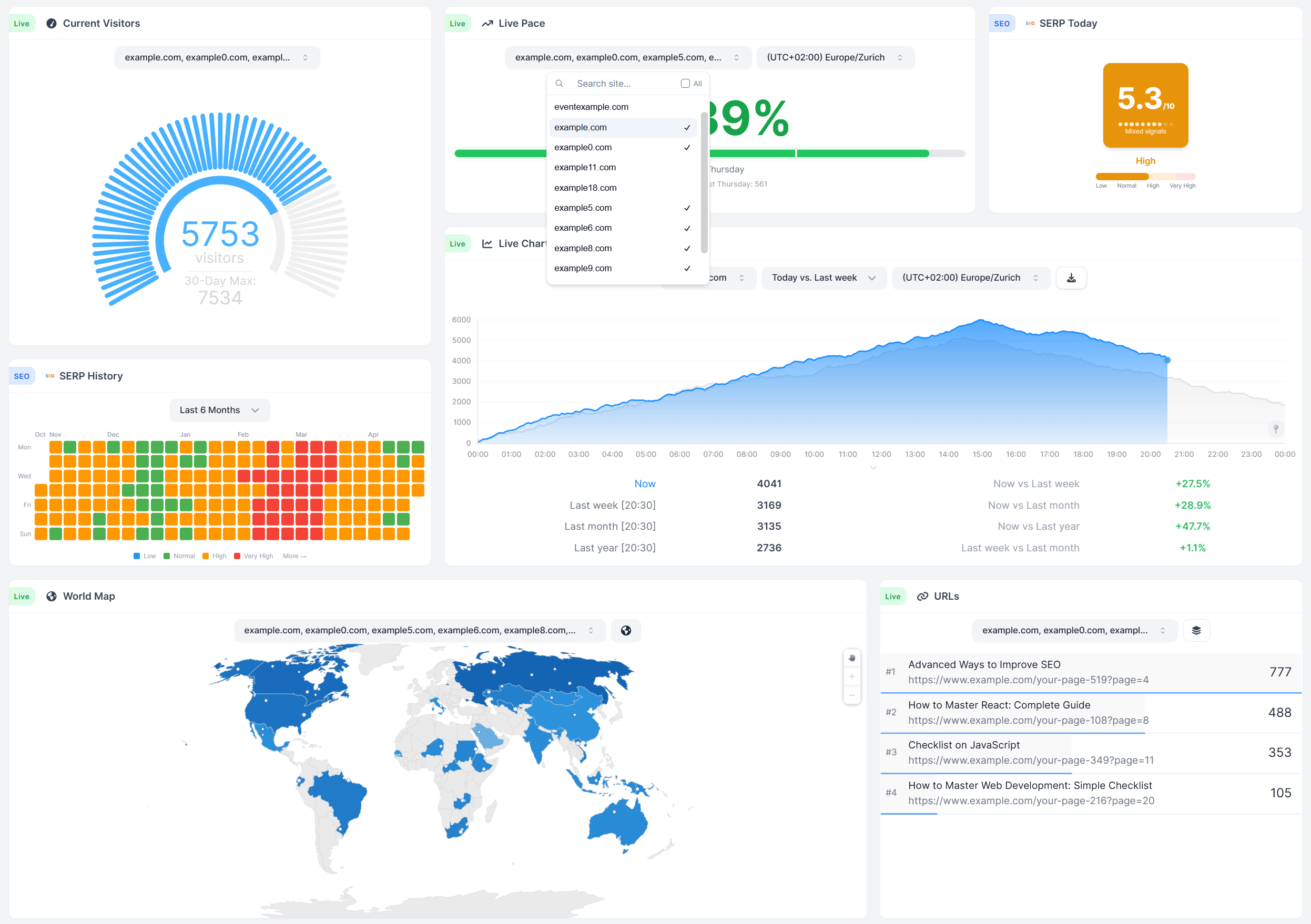
An integrated SEO suite (SERP volatility, Google updates, holiday overlay). SERP Volatility live tracking, the Google Core and Spam Updates timeline, and a per-country holiday annotation layer, all sitting beside the traffic charts. Matomo's marketplace offers SEO Web Vitals and a Search Engine Keywords Performance plugin, but neither covers SERP-wide volatility or a Google-update timeline. The day Google rolls a core update, that gap is what saves you the next half hour of guesswork.
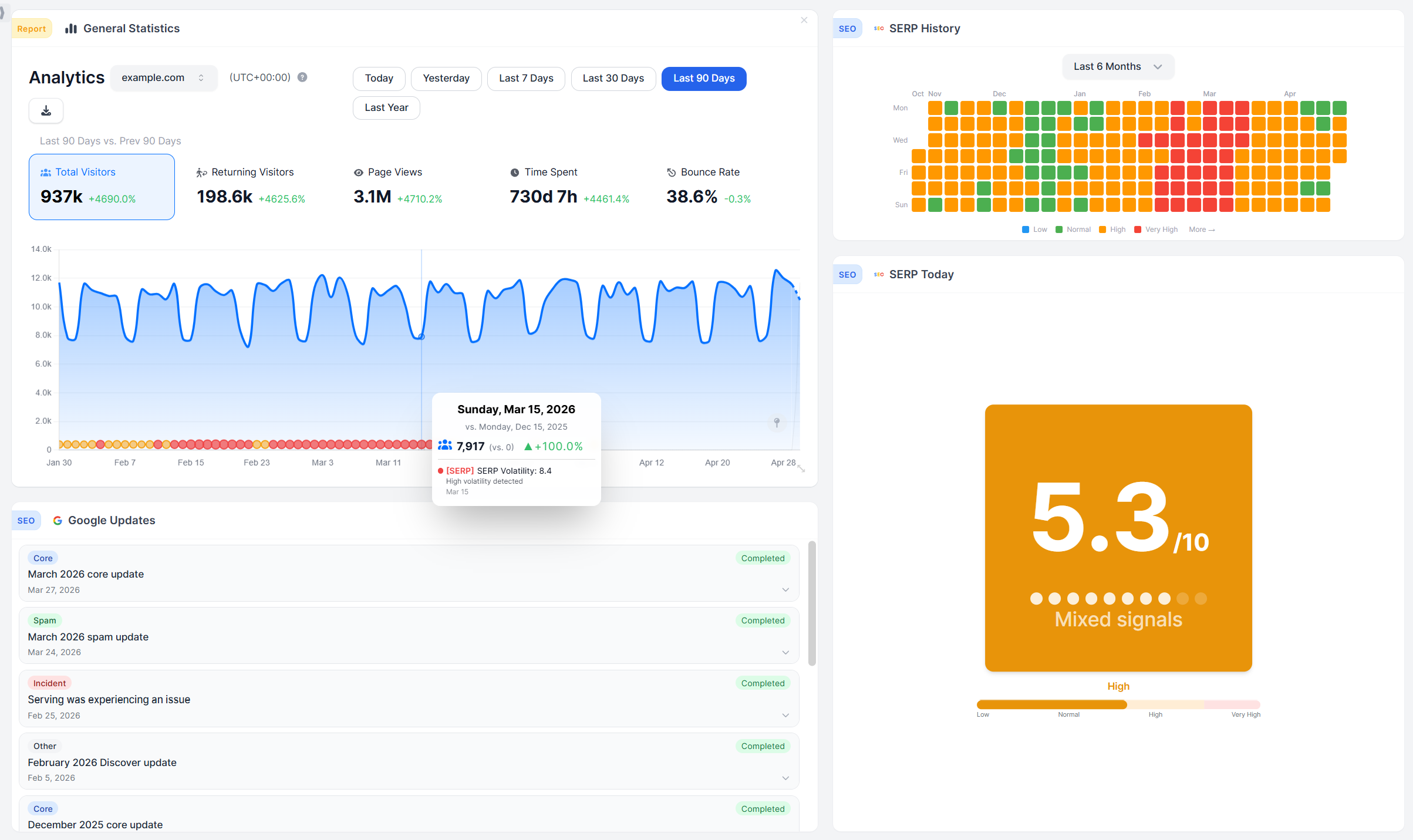
A widget catalogue built around per-site multi-board organisation. 60+ widgets, three themes (Light, Dark, Future), and several dashboards per site. Matomo ships drag-and-drop dashboards too, which is welcome; WireBoard's surface adds wider widget breadth, multi-board layout per site, and a fully populated default board the moment you sign up rather than a blank canvas waiting on configuration.
A four-layer annotation system on every time-axis chart. My Events, Google Updates, SERP Volatility, and Public Holidays painted on top of every time series, plus per-user notes. Matomo ships chart annotations as well, but without the SERP-volatility and Google-update overlays.
Funnels, revenue tracking, and custom event properties on every plan, including free. Matomo's Funnels ship inside Cloud Business but are a yearly paid plugin on the On-Premise side; WireBoard ships funnels on the permanent Free Plan with no add-on to buy on either side.
A public API with a Live event stream, not just a Reporting endpoint. Matomo's Reporting API has been around forever and is excellent for batch pulls. WireBoard ships the same kind of REST surface (account, sites, aggregate, timeseries, breakdowns, URL explorer, custom events) plus a Live API over Server-Sent Events: subscribe once and visitor activity streams to your code the moment it lands. Official JavaScript and Python SDKs, plus an MCP server so Claude (and other LLM agents) can query your analytics in conversation. REST is on every plan including Free (30-day history cap on Free); the Live stream is on every paid plan.
Streamer Mode and Shift+C dashboard screenshots. Blur your domains, URLs, and titles for client demos and screen shares; one keystroke saves a PNG of any board.
Three-year retention on every paid plan. Matomo Cloud Business retains raw data for 24 months and keeps aggregated reports beyond. WireBoard gives you three years of raw data from the nine-dollar Micro plan upward.
Should WireBoard be your Matomo alternative?
Matomo's marketplace works if you assemble heatmaps, session recordings, A/B testing, and form analytics plugin by plugin. WireBoard's approach is the opposite: every analytics feature on by default, on every plan, including the permanent free one. The live widgets stream from sign-up: visitor counter, world map, referrer panel, and event feed, all updating the moment a hit lands. The composition is yours, with sixty-plus drag-and-drop widgets, multiple boards per site, and three themes.
Running several sites and reading them live? A multi-site widget aggregates the lot into one streaming view. Watching a Google update? SERP volatility and the core-and-spam-update timeline are right there on your traffic dashboard. Tracking conversions with revenue per goal property? On every plan, no premium plugin required.
Matomo stays the right answer when self-hosting on your own infrastructure is non-negotiable, when the ISO 27001 paperwork Matomo Cloud publishes is part of procurement, or when the plugin ecosystem (heatmaps, session replays, A/B testing) is doing real work for you. For everyone else, every feature ships on every WireBoard plan, the Free Plan covers 50,000 pageviews on two sites and three boards, and WireBoard is the Matomo alternative that comes assembled.
Should you trust this comparison?
Fair to ask. The disclosure:
I run WireBoard. I have used Matomo, talked to operators who chose it over us, and gone through their plugin marketplace, pricing page, and FAQ catalogue more times than is probably healthy. The piece below is the comparison I keep wishing existed when prospects ask which one fits them. When Matomo is the stronger pick, you will see me say so. When WireBoard is, the same applies, with sources for the claims.
Two more weights for the scale.
Where the claims come from. Every claim about Matomo points at their public documentation, marketplace listings, or pricing page, all linked at the bottom of the post. Every claim about WireBoard reflects what we ship today, including the public API at api.wireboard.io (read-only REST on every plan with a 30-day history cap on Free; Live Server-Sent Events on every paid plan; official JavaScript and Python SDKs plus an MCP server for Claude and other LLM agents). A few items live on our roadmap (Slack-native reporting, configurable traffic-spike alerts, webhooks); each is flagged with that exact framing.
Who picks WireBoard. Three customers worth naming. Barry Schwartz at Search Engine Roundtable lives inside a SERP-volatility dashboard during Google update windows. Robert Farrington at The College Investor watches a high-traffic publication where editorial decisions ride on what the live numbers say. Jon James at TeamGreet runs a SaaS funnel and reads conversion math off the dashboard daily. Different jobs, same reason for the choice: the live surface is not a checkbox, it is the workflow. Compare that shape against your own.
How the pricing actually plays out
Prices below were recorded from each company's published pricing page in May 2026. Both Matomo and WireBoard adjust pricing periodically. Before making a buying decision, verify current rates on the Matomo pricing page and the WireBoard pricing page.
The two pricing models reflect the two theories. Matomo charges by hits per month for Cloud and by yearly plugin subscriptions for On-Premise; the cheapest sticker price hides the fact that depth is bought feature by feature. WireBoard charges by quotas (pageviews, sites, dashboards, seats, retention) and includes every feature on every paid tier; the sticker price covers the whole product.
Matomo's tiers
Matomo Cloud Business starts at €29 per month for 50,000 hits, with annual billing offering "two months free" (about 17% off) per Matomo's own pricing copy. The Cloud Business plan caps at 30 websites, 30 team members, 100 segments, 150 goals, and 24-month raw data retention. Above 50,000 hits the price scales by hit volume; above 10 million hits per month, Cloud moves to custom Enterprise pricing. Always verify current rates on the Matomo pricing page before budgeting.
| Matomo option | Entry rate | Hits/mo | Notes |
|---|---|---|---|
| On-Premise (GPL v3 core) | Free + server cost | Unlimited | Premium features as paid yearly plugins (heatmaps, A/B, etc.) |
| Cloud Business at 50k | from €29/mo | 50,000 | 30 websites, 30 team members, 100 segments, 150 goals |
| Cloud Business at 1M | scales by volume | 1,000,000 | Same plan structure, scaled allowances |
| Cloud Business at 5M | scales by volume | 5,000,000 | Same plan structure, scaled allowances |
| Cloud Enterprise | Custom | Custom | Custom allowances, SLAs, data residency |
On-Premise headline plugin prices for reference: Heatmap & Session Recording from €219/yr, A/B Testing from €219/yr, Funnels from €193/yr, Form Analytics from €169/yr, SAML SSO from €549/yr.
WireBoard's tiers
WireBoard ships nine plans starting at zero dollars forever. Yearly billing trims about 17% (two months free). Every paid tier includes every feature.
| WireBoard plan | Monthly | Pageviews/mo | Sites | Dashboards | Team seats | History |
|---|---|---|---|---|---|---|
| Free Plan | $0 | 50,000 | 2 | 3 | 1 | 30 days |
| Micro | $9 | 100,000 | 50 | 100 | 3 | 3 years |
| Small | $19 | 250,000 | 50 | 100 | 5 | 3 years |
| Medium | $24 | 500,000 | 50 | 100 | 10 | 3 years |
| Large | $49 | 1,000,000 | 50 | 100 | 15 | 3 years |
| Extra Large | $99 | 3,000,000 | 50 | 100 | 20 | 3 years |
| Pro | $199 | 6,000,000 | 50 | 100 | 30 | 3 years |
| Pro Plus | $399 | 12,000,000 | 100 | 200 | 50 | 3 years |
| Enterprise | Custom | Custom | Unlimited | Unlimited | Unlimited | Custom |
Same volume, side by side
Both products count any tracked hit toward the monthly quota: pageviews and custom events alike. WireBoard markets the quota as "page views" and Matomo markets it as "hits" (pageviews, events, downloads, outlinks, on-site searches), but the underlying counting is the same. So one million tracked hits a month on either product corresponds to the same row below. USD and EUR are kept as published.
Verify current Matomo rates on their pricing page, since Cloud rates scale by volume and the dropdown drives the displayed monthly price.
| Volume | WireBoard | Matomo Cloud Business | Where the math lands |
|---|---|---|---|
| 50k / month | Free Plan ($0) | from €29/mo | WireBoard wins on price; Matomo wins on retention (24 months vs 30 days on Free) |
| 100k / month | $9/mo (Micro) | scales by volume | WireBoard wins on raw cost and on site count (50 sites vs 30) |
| 1M / month | $49/mo (Large), every feature | scales by volume + plugin add-ons for heatmaps, A/B, recording | WireBoard wins on capability per dollar; Matomo wins on session-replay depth at extra spend |
| 5M / month | $99/mo (Extra Large) | scales by volume | WireBoard wins on raw cost at scale |
Three differences that move the buying decision
- Bundle versus menu. A small business at 50,000 hits pays nothing on WireBoard for the same feature surface (funnels, custom events, multi-site, SERP volatility, every dashboard widget) it would build on Matomo by stacking Cloud Business with one or more premium plugin allowances. The "cheapest plan" comparison flips the moment you start adding the depth a real analytics workflow needs.
- No tier-gated funnels, revenue tracking, or multi-site. WireBoard ships funnels, revenue tracking with custom event properties, multi-site live aggregation, the SEO suite, embed tokens, Streamer Mode, and three-year retention on every paid tier, including the Free Plan. On Matomo, Funnels are included on Cloud Business but a yearly paid plugin On-Premise; Roll-Up Reporting follows the same pattern; Heatmap and Session Recording run on per-tier monthly allowances.
- One predictable line item, or a stack of yearly plugin invoices. Matomo's marketplace makes a la carte budgeting possible at the cost of more invoices to track. WireBoard's pricing is one monthly line for the whole product. Pick the model your finance team prefers.
Try both on your own data
Theory only takes you so far. Put them next to each other.
WireBoard's Free Plan never expires (no card, every feature). Matomo offers a 21-day Cloud trial; if you prefer to skip trials entirely, the On-Premise edition is free to install on a small VPS. Add both trackers to one site you actually run.
Three quick comparisons that settle it faster than any review:
- Watch both dashboards at the same time. Browse to a page yourself, or have a colleague do it. Notice how each surface acknowledges the visit and on what cadence. Streaming vs five-second polling reads as obvious the moment you can see both.
- Catch a busy window. Push a tiny ad, post the URL where it will get clicks, or wait for organic on a high-volume page. Decide which dashboard would be your default during a real launch.
- Throw a real question at each. Pick something off your last sprint review: "Which UTM beat the rest yesterday?" "Did the redesigned signup convert better?" "Is anyone bouncing harder by country?" The one that answers it without making you build a report wins on the work you actually do.
Once you have done that, the three decisions above stop being abstract.
Pros and cons at a glance
| WireBoard | Matomo | |
|---|---|---|
| + | ✅ True real-time, streaming live ✅ 60+ widgets, fully customizable ✅ Multi-site live in one view ✅ SERP volatility + Google update tracking ✅ Public API with a Live (SSE) stream, rare in this market ✅ Every feature on every plan, even free |
✅ Open source, self-hostable ✅ Heatmaps + session recording ✅ A/B testing + form analytics ✅ Lower raw cost at scale (On-Premise) |
| − | ❌ No self-hosting ❌ No session replay ❌ No native A/B test engine |
❌ 5-second auto-refresh, not streaming ❌ Premium features sold per plugin ❌ No SERP / Google-update tracking ❌ Higher raw cost at scale (Cloud) ❌ On-Premise depth needs paid plugins |
The bottom line
Matomo is the right pick in three narrow situations: open-source self-hosting is non-negotiable for your stack, you actively use heatmaps, session recording, A/B testing, or form analytics in your weekly workflow, or your procurement process specifically requires the ISO 27001 paperwork Matomo Cloud publishes.
For everyone else, WireBoard wins. Live streaming widgets that surface a visit as it lands. A dashboard system with sixty-plus widgets and multiple boards per site, organised the way your team actually reads data. One widget that aggregates live traffic across your whole portfolio. SERP volatility and a Google update timeline alongside your analytics on the same page. Every paid tier ships every feature, the Free Plan included. No premium plugins to budget separately, no tier-unlock to negotiate, no per-feature invoice stack.
Start tracking for free with WireBoard. 50,000 pageviews per month, 2 websites, 3 dashboards, every feature included. No credit card. No trial period. No catch.
Sources
WireBoard
- WireBoard homepage
- WireBoard pricing
- WireBoard features
- SERP volatility live tool
- Google Core and Spam Updates timeline
- WireBoard product timeline and changelog
- WireBoard privacy policy
- WireBoard documentation
Matomo (where the claims about their product are grounded)
- Matomo pricing page
- Matomo Plugins Marketplace
- Matomo real-time reports user guide
- Matomo On-Premise overview
- Matomo Cloud overview
EU data protection and infrastructure