


Which should you pick: WireBoard or Fathom Analytics?
Both are sold as a calmer alternative to Google Analytics 4, and both run cookieless options. They diverge once you watch how a working week plays out on each dashboard.
Pick Fathom Analytics if your idea of good analytics is one page you never have to set up, fixed layout, same view for everyone, read in under a minute. A long-established public API with account-level entity management and an open-source self-hostable companion (Fathom Lite) come along with it.
Pick WireBoard if your week is paced by launches, ad runs and algorithm-rumble mornings; if you watch a portfolio of sites and want their live traffic merged into one widget; if you build conversion paths and need real-time funnels with revenue per goal property; or if SERP volatility and Google algorithm rollouts belong on the same screen as your visitor charts.
Read on for the scoreboard, the five workdays where the two tools play differently, where Fathom wins, where WireBoard wins, the pricing math, and a way to put both on a real site.
At a glance
WireBoard | Fathom Analytics | |
|---|---|---|
Real-time surface | Streaming live widgets, real-time funnels, live event feed | Live visitors box on the single dashboard page |
Dashboard | 60+ widgets, multiple per site, three themes, populated default | One single dashboard page, fixed layout |
Multi-site live aggregation | Yes, in one widget, streaming | All-sites overview: per-site cards on a separate screen |
SEO suite (SERP volatility, Google updates) | Included on every plan | Not offered |
Annotations layer on time-axis charts | Four built-in layers + per-user notes | Not offered |
Funnels | Real-time, flexible order, every plan | Not offered (events for goal and conversion tracking) |
Permanent free plan | Yes, every feature, 50k PV/mo | No (30-day free trial only) |
Entry-point price | $9/mo (Micro): 100k PV, 50 sites, 3 seats | $15/mo: 100k PV, up to 50 sites |
Price for 1,000,000 pageviews/mo | $49/mo (Large) | $60/mo |
Read-only public API | Yes, REST on every plan + Live (SSE) stream on paid plans | Yes, REST on every plan |
Data retention | 30 days (Free) / 3 years (paid) | Kept on dashboard, no stated cap |
Open-source self-host option | No | Fathom Lite (separate, open-source) |
Ad-blocker resilience | Tracker built to keep capturing past common blockers | Custom-domain CNAME bypass |
Cookieless mode | Optional toggle, off by default for accuracy | Always on, no toggle |
Hosting and data path | Full in-house pipeline on EU infrastructure | EU isolation routes EU IPs to EU servers; anonymous data stored on US main infrastructure |
Stop comparing on simplicity. Both are simpler than GA4. That's not the call.
Most reviews of either product open with the same line: "simpler than Google Analytics, no consent banner, easier to read." The frame is not wrong. It is also not where a working buyer's choice lives.
Fathom defines simplicity as a single dashboard with a fixed layout and a small, deliberate feature surface. WireBoard defines simplicity as a populated default dashboard on day one, with the option to keep adding widgets and boards as your work grows. Either is simpler than GA4. They are not the same shape of simple. Picking on the word "simple" is picking blind.
Project yourself into the next five working days and ask which dashboard you would actually want open in a tab. That is the call this post is built around.
Five workdays where the two dashboards play differently
I have used both products on real sites. The differences I keep hitting are not abstract philosophies. They land on specific moments in a week.
1. Launch Tuesday, 2 pm: a tweet just landed
You ship at lunch and post about it. Within minutes you want to see whether the post moved anyone, whether they are reading the launch page or bouncing, and whether the referrer shows up the way you tagged it.
Fathom Analytics shows a live visitors box with the current visitor count and the page they are reading, plus the totals row at the top. For a single-page launch read, that is enough.
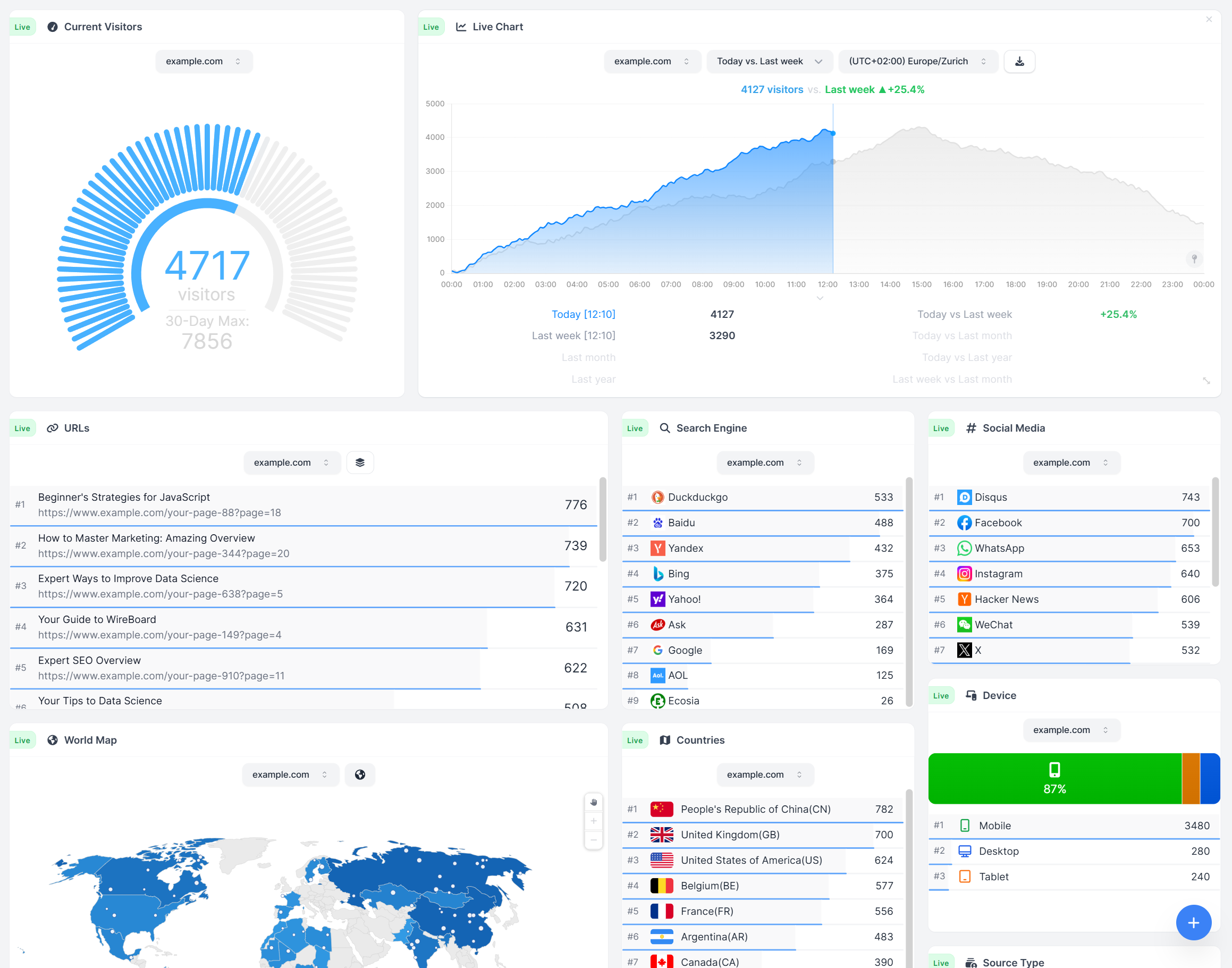
WireBoard streams. Two live widgets lead: a live count of concurrent visitors and a live view of which pages they are reading. Behind those, the live world map, live traffic sources, live device breakdown, real-time funnels with live drop-off, and the rest of the 20+ live widgets. The live event feed pushes the moment a custom event fires. With a real-time funnel pinned for the launch flow, you watch the cohort fall through it as it happens.
If you check analytics once during launch, Fathom's box covers it. If you keep the tab open during ad blasts, the streaming surface is what makes WireBoard worth watching.
2. Saturday morning: Google's algorithm just shifted
You wake up to panicked DMs. Did Google push something overnight? Is your traffic dropping because a redirect broke, or because a Core Update is reshuffling rankings?
Fathom will show you the traffic shape across days, weeks and months. What it does not show is whether the broader SERP is volatile right now or whether a Google rollout is in progress.
WireBoard ships an SEO suite next to the analytics: a SERP Volatility live dashboard, a Google Core and Spam Updates timeline, and a per-country holiday annotation overlay that drops onto every time-axis chart. On a panic morning, the briefing is thirty seconds: open the SERP score, check the update timeline, scan whether other sites are seeing the same turbulence. Traffic and algorithm context sit in the same product. If your work depends on Google rankings, this is the gap most reviews leave out.
3. Monday 9 am: every client wants a status update
If you run an agency or a small portfolio, Monday is when you find out which property needs attention before anyone calls you.
Fathom Analytics has an All Sites view: account totals plus per-site cards on a single screen. You can share a site's dashboard publicly or behind a password.
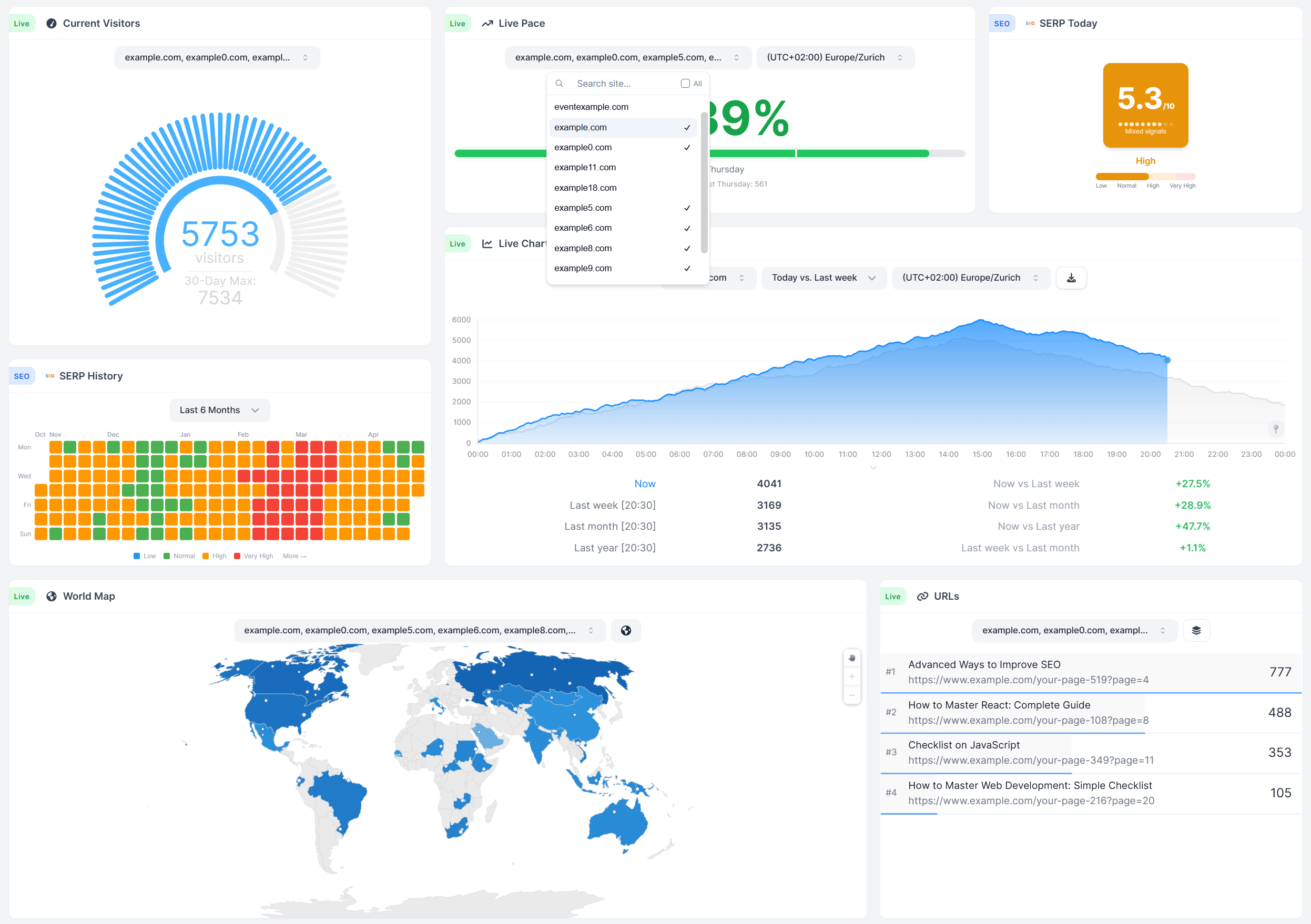
WireBoard answers the cross-site question differently. Pick any subset of your sites and the live numbers merge into one streaming widget, the same widget you would otherwise use for a single site. Embed tokens drop a live dashboard inside a client portal. Streamer Mode blurs your domains for screen sharing. Three themes plus multiple boards per site let a client-facing board look different from your operations board.
Plain language: Fathom gives you a per-site overview screen. WireBoard gives you live aggregated cross-site traffic in one widget, plus the embed and screen-sharing tooling agencies use during a client week.
4. Friday afternoon: the weekly review
Friday is the calmer half of the week. You read what happened, write a short note for your team, and schedule next week's email report.
Fathom is built for exactly this read. One dashboard, a totals box at the top, data boxes for pages, referrers, sources, devices, browsers, countries, events and UTMs. The March 2026 rebuild added secondary dimensions in the detail view (Pages by Country, Referrers by Browser), a chart-type switcher, more date-grouping options and per-box CSV export. Email reports go out weekly or monthly.
WireBoard answers the same question differently. Sign up and you land on a populated default dashboard. From there you build a weekly-review board with period-vs-period widgets, the URL Explorer for any page's full history, and the visitor activity heatmap. A separate live operations board and a client-facing board live on the same site. Exports cover CSV, JSON, XLS, XLSX and ODS; recurring exports drop into S3, FTP or SFTP.
Fathom keeps a single layout fixed for everyone. WireBoard hands you the keys to change it. Onboarding speed is the same; the ceiling is not.
5. Wednesday 4 pm: an engineer wants the raw numbers
A developer pings you. They want to pull metrics into an internal status page or a Slack bot.
Fathom has a public API on every plan: a current-visitors endpoint, an aggregations endpoint covering visits, uniques, pageviews, average duration and bounce rate, plus account-level entity management.
WireBoard now ships a public API too. The REST surface is read-only on every plan and covers account, sites, aggregate reports, time-series, breakdowns, the URL explorer and custom events. A Server-Sent Events Live API on paid plans streams 20 categories of visitor activity in real time, so a Slack bot or internal status page can react the moment a hit lands instead of polling. Official SDKs ship for JavaScript/TypeScript/Node (@wireboard/api) and Python (wireboard-api), plus an MCP server so Claude or another LLM agent can query your analytics inline. The export pipeline is still there for batch use cases: every widget exports to CSV, JSON, XLS, XLSX or ODS on demand, and recurring exports push to S3, FTP or SFTP.
On the API call, the two products are now close. Fathom's edge is the longer track record and account-level entity management (create and modify sites programmatically). WireBoard's edge is the Live SSE stream and the MCP server for AI clients.
What Fathom Analytics does better than WireBoard today
A short, honest list. If any of these matter to your team, Fathom may be the better fit.
A more mature public footprint. Fathom has been in market since 2018, with a long-running blog, a podcast, and a customer roster that includes Bootstrap, IBM, HashiCorp, GitHub and Laravel. If the size of the public track record is what tips a buying decision in your shop, Fathom wins it.
Fathom Lite, an open-source self-host option. Fathom publishes Fathom Lite under MIT. It is not the cloud product, but if you want to run an analytics tool on your own server with the source code in hand, Fathom gives you that path. WireBoard is cloud-only.
A CNAME-routed tracking domain. Fathom lets every customer set up a custom subdomain so the tracking script loads from a first-party hostname. WireBoard tackles the ad-blocker problem differently, the tracker keeps capturing visits past common blockers, but does not offer a CNAME proxy if first-party routing is mandatory in your stack.
A longer-established public API with entity management. Both products now ship a read-only public API on every plan. Fathom's has been in production for years and offers account-level entity management, so you can create and modify sites programmatically. WireBoard's API is read-only in v1: dashboards, widgets and sites are configured through the web app.
What WireBoard offers that Fathom Analytics doesn't
The flip side. Each item below is a capability shipped today on WireBoard that has no equivalent in Fathom's public documentation.
Streaming live widgets across the surface. Two leads: a live count of concurrent visitors and a live view of which pages they are reading. Behind them: the live world map, live traffic sources, live device breakdown, real-time funnels with live drop-off, and the rest of the 20+ live widgets.
60+ widgets, drag-and-drop, multiple dashboards per site, three themes. A live operations board, a weekly review board, a client-facing board, all on the same site, with a populated default template on sign-up.
Multi-site live aggregation, one widget. Pick any subset of your sites and the live numbers merge into the same widget you would otherwise use for a single site.
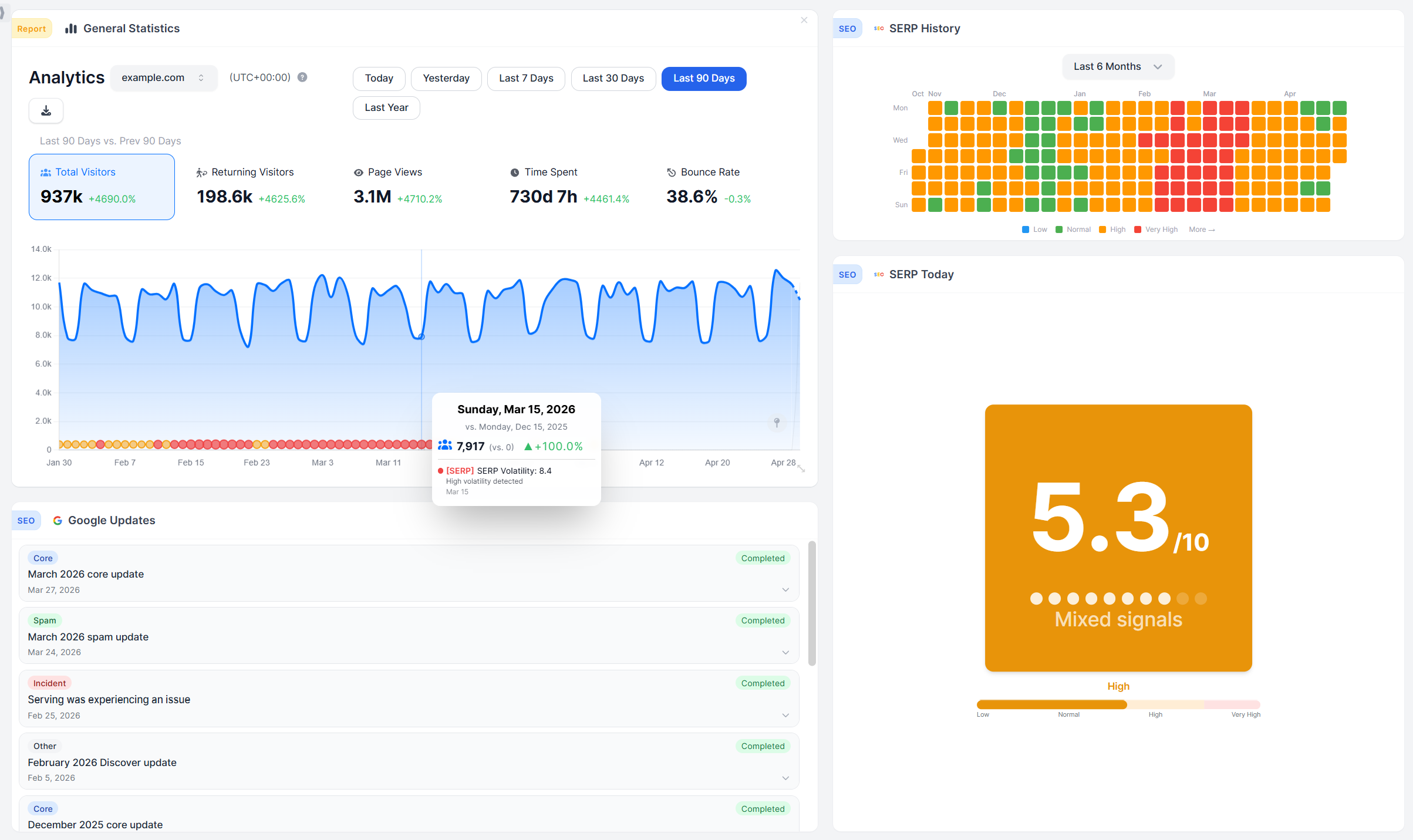
SERP volatility, Google update tracking, holiday overlay. The SERP Volatility live dashboard, the Google Core and Spam Updates timeline, and the per-country holiday annotation layer.
Real-time funnels with flexible order, on every plan. Mix sessions, pageviews and events in any order, with live drop-off as visitors progress. Fathom does not currently ship multi-step funnel analysis.
Time-axis annotations on every chart. Four shipped layers, My Events, Google Updates, SERP Volatility and Public Holidays, sit alongside your own per-user notes on any chart with a time dimension.
Streamer Mode and one-keystroke screenshot capture. For client demos and screen sharing without revealing your domains, URLs or page titles.
Permanent free plan with every feature. WireBoard's Free Plan covers 50,000 pageviews per month, 2 sites, 3 dashboards, every feature, no card, no expiry. Fathom does not offer a free tier.
Where WireBoard fits as a Fathom Analytics alternative
The single Fathom dashboard page is part of why people pick Fathom, and it works until you start needing more from the surface. Live data is the first move. The visitor counter, the world map, the referrer panel, and the event feed all advance the moment a hit lands. Watch it during a flash sale or product launch and you see every visitor arrive. Around that, WireBoard ships sixty-plus drag-and-drop widgets, multiple boards per site, three themes, and a populated default template the minute you sign up.
Building a real-time funnel? Fathom does not ship funnels; WireBoard ships them on every plan, even the free one. Running a portfolio? A multi-site widget rolls every site into one live streaming view. Algorithm-rumble morning? SERP volatility and the core-and-spam-update timeline sit right next to your traffic.
The Fathom posture you may not want to give up is the Fathom Lite open-source companion; WireBoard does not ship that today. For everything else, the permanent Free Plan covers 50,000 pageviews on two sites and three boards, every paid feature is on every paid tier, and WireBoard is the Fathom Analytics alternative built for the surface that goes wider.
Should you trust this comparison?
Fair question.
I run WireBoard. I have used Fathom Analytics, read their docs and changelog, and watched plenty of teams make this same call. Where Fathom is the better fit, I will tell you. Where WireBoard wins, I will tell you that too, and back it up.
Verifiability. Every Fathom claim above traces back to their public docs, pricing page or the March 2026 changelog, all linked at the bottom. Every WireBoard claim traces back to shipping product. Where something on our side is roadmap rather than live (Slack-native reporting, configurable traffic-spike alerts), I have flagged it inline.
Customer signal. WireBoard is used by people whose work depends on watching traffic in real time, including Barry Schwartz of Search Engine Roundtable (who covers Google algorithm updates daily), Robert Farrington of The College Investor, and Jon James of TeamGreet. Their workloads track closely with the workdays above.
How the pricing actually plays out
Prices below were recorded from each company's published pricing page in May 2026. Both Fathom Analytics and WireBoard adjust pricing periodically. Before making a buying decision, verify current rates on the Fathom Analytics pricing page and the WireBoard pricing page.
Fathom prices by pageview tier on a single plan, every feature included. WireBoard prices by quotas across multiple tiers, every feature included at every plan including free.
Fathom Analytics tiers
Yearly billing saves about 17%. Free trial is 30 days; no permanent free tier.
Pageviews/mo | Monthly | Yearly | Sites |
|---|---|---|---|
Up to 100,000 | $15 | $150 | up to 50 |
Up to 500,000 | $45 | $450 | up to 50 |
Up to 1,000,000 | $60 | $600 | up to 50 |
Up to 5,000,000 | $140 | $1,400 | up to 50 |
Up to 25,000,000 | $470 | $4,700 | up to 50 |
Custom event tracking counts toward the pageview quota.
WireBoard tiers
WireBoard ships nine plans starting at $0 forever. Yearly billing saves about 17%. Every paid tier and the Free Plan include every feature.
Plan | Monthly | Pageviews/mo | Sites | Dashboards | Team seats | History |
|---|---|---|---|---|---|---|
Free Plan | $0 | 50,000 | 2 | 3 | 1 | 30 days |
Micro | $9 | 100,000 | 50 | 100 | 3 | 3 years |
Small | $19 | 250,000 | 50 | 100 | 5 | 3 years |
Medium | $24 | 500,000 | 50 | 100 | 10 | 3 years |
Large | $49 | 1,000,000 | 50 | 100 | 15 | 3 years |
Extra Large | $99 | 3,000,000 | 50 | 100 | 20 | 3 years |
Pro | $199 | 6,000,000 | 50 | 100 | 30 | 3 years |
Pro Plus | $399 | 12,000,000 | 100 | 200 | 50 | 3 years |
Enterprise | Custom | Custom | Unlimited | Unlimited | Unlimited | Custom |
Same volume, side by side
Pageviews/month | WireBoard | Fathom Analytics | You save with WireBoard |
|---|---|---|---|
50,000 | Free | $15/mo (100k tier) | $15/mo |
100,000 | $9/mo (Micro) | $15/mo | 40% |
500,000 | $24/mo (Medium) | $45/mo | 47% |
1,000,000 | $49/mo (Large) | $60/mo | 18% |
Pageview quotas do not align tier-for-tier perfectly, so each row uses each product's nearest-fit plan at the named volume. Both products count any tracked hit toward the monthly quota; the underlying counting is the same.
Three differences that move the buying decision
WireBoard is lower-cost at every common pageview tier. At 1,000,000 pageviews per month, $49 versus $60 saves $132 a year. At 100,000 pageviews per month, $9 versus $15 saves $72 a year.
WireBoard has a permanent free plan; Fathom does not. The Free Plan covers 50,000 pageviews, 2 sites, 3 dashboards, every feature, no card, no expiry. Fathom offers a 30-day free trial; after that, you pay or you stop.
Both products include every feature on every paid plan. Neither one feature-gates funnels, revenue or events behind premium tiers. The call shifts to feature surface and price per pageview.
Still not sure? Install both side by side.
Reading is the slow way to make this call. Putting both on a real site is the fast way.
Fathom has a 30-day free trial. WireBoard's Free Plan never expires. Drop the script tag for each on one of your real sites, send some traffic, and watch what happens on each dashboard.
Open both dashboards on a single screen. Send a real visit (or have a teammate send one). Watch how each tool surfaces it.
Pick a moment that maps to one of the five workdays above. A small ad burst, a tweet, a deploy, a client call. Note which dashboard you actually want open during that moment.
Try to answer one question that matters to your work. "Which UTM converted yesterday by country?" "Did the deploy at 2 pm move bounce rate?" "Which client site needs attention before the 10 am call?" Whichever tool gets you the answer faster wins on your specific job.
Pros and cons at a glance
WireBoard | Fathom Analytics | |
|---|---|---|
+ | ✅ True real-time, streaming live | ✅ Longer-established public API with account-level entity management |
− | ❌ No custom-domain CNAME proxy | ❌ Single fixed dashboard |
The bottom line
Fathom Analytics is the right pick if you want one page, fixed layout, zero setup, and you are willing to trade real-time streaming, multi-site live aggregation, and SERP context for that simplicity. Fathom Lite and the CNAME-routed tracking domain are extras you get along the way; they are not the reason to buy.
For everyone else, WireBoard is the answer. Live traffic streamed across many widgets the moment a visitor lands. Sixty-plus drag-and-drop widgets and multiple dashboards per site, with a populated default board on day one. Live multi-site aggregation in one widget. Real-time funnels with flexible order. SERP volatility and Google algorithm-update tracking next to your traffic. Every feature on every paid tier, permanent Free Plan included. No tier-gated funnels, no tier-gated revenue, no asterisks.
Start tracking for free with WireBoard. 50,000 pageviews per month, 2 websites, 3 dashboards, every feature included. No credit card. No trial period. No catch.
Sources
WireBoard
Fathom Analytics (where the claims about their product are grounded)
EU data protection and infrastructure