


The answer in 30 seconds
WireBoard is a real-time web analytics platform. Hotjar is a behavior analytics platform now owned by Contentsquare. The first answers "what is happening on my site right now, and how is the trend moving?" The second answers "why did that specific visitor rage-click on that specific button?"
Pick Hotjar if you spend your day:
Watching individual users move through a checkout, signup, or onboarding flow
Looking for friction points by replaying real sessions
Running on-page surveys, polls, or NPS prompts
Recruiting users for interview-based research
Pick WireBoard if you spend your day:
Watching live traffic during launches, sales, posts, or Google update days
Tracking goals, funnels, revenue, and UTM campaigns across one or many sites
Building dashboards your way for review meetings or client demos
Watching SERP volatility and Google core and spam updates next to your traffic charts
Read on for where the two actually overlap, where each one wins, what they really cost, and the case for running both.
At a glance
WireBoard | Hotjar | |
|---|---|---|
Product category | Real-time web analytics | Behavior analytics (heatmaps, recordings, surveys) |
Live visitor count, streaming | Yes | Not the core experience |
Heatmaps | No | Yes (core feature) |
Session recordings | No | Yes (core feature) |
Surveys and feedback widgets | No | Yes (Ask product) |
Customizable dashboards | 60+ widgets, drag-and-drop | Trends and funnels saved to dashboards |
Custom events, funnels, UTM, goals | Yes, every plan | Yes, on paid plans |
Multi-site live aggregation | Yes, in one widget | Per-site only |
SERP volatility + Google update tracking | Yes | No |
Public API | REST on every plan (incl. free), Live SSE on paid; official JS + Python SDKs and MCP server | Events API on paid (ingestion), no public analytics-read API |
EU hosting | EU only, in-house pipeline | EU (AWS), part of Contentsquare |
Free plan | 50,000 page views/mo, every feature | 35 sessions/day (Observe Basic) |
Entry paid plan | Micro $9/mo (100,000 page views) | Observe Plus $39/mo ($32/mo annual), 100 daily sessions |
1M page views reference | Large $49/mo | Observe Scale $213/mo ($171/mo annual), 1,500 daily sessions, sampled past the cap |
Data retention (free) | 30 days | 12 months |
Data retention (paid) | 3 years on every paid plan | Plan-dependent |
Team seats | Up to 50 by plan | Unlimited on every plan |
Why "WireBoard vs Hotjar" is a different shape of comparison
Every other comparison on this site pits WireBoard against another web analytics tool. Plausible, Fathom, Umami, Matomo, GA4. Different vendor, same product category. The reader's job there is to pick one.
Hotjar is not in that category. Hotjar's own product copy positions it as "the perfect complement to your web traffic analytics tools," not a replacement for them. That sentence sits on hotjar.com, not in a third-party review. It is the company telling you, plainly, that Hotjar sits next to your analytics, not in place of it.
So the search "WireBoard vs Hotjar" usually means one of three things, and only one of them is "which of these two should I buy and uninstall the other?"
"My web analytics is broken or I dislike it, and I am also looking at Hotjar." WireBoard is the answer here. Hotjar will not give you a live traffic dashboard, full traffic-source breakdowns, multi-site aggregation, or SERP tracking.
"I have web analytics already and I want to add Hotjar, but Hotjar is expensive." You may want to switch your analytics to WireBoard and add Hotjar Observe on top, or stay on what you have and run Hotjar next to it. The real decision is whether the behavior-analytics half is worth the bill.
"I want one tool that does everything." That tool does not exist between these two products. Pick the question you care about more and add the other when the budget allows.
The rest of this post is structured around the second framing, which is where most real-world buyers actually land.
The two questions, the two products
Every site owner ends up asking two questions about their site. They look related but they need different tools to answer.
Question one: what is happening on my site, in aggregate, right now and over time? How many visitors are here. Where they came from. Which pages they landed on. Which campaigns paid off. How conversion is trending this week vs last. Whether traffic just spiked because a tweet went viral or a bot wave hit.
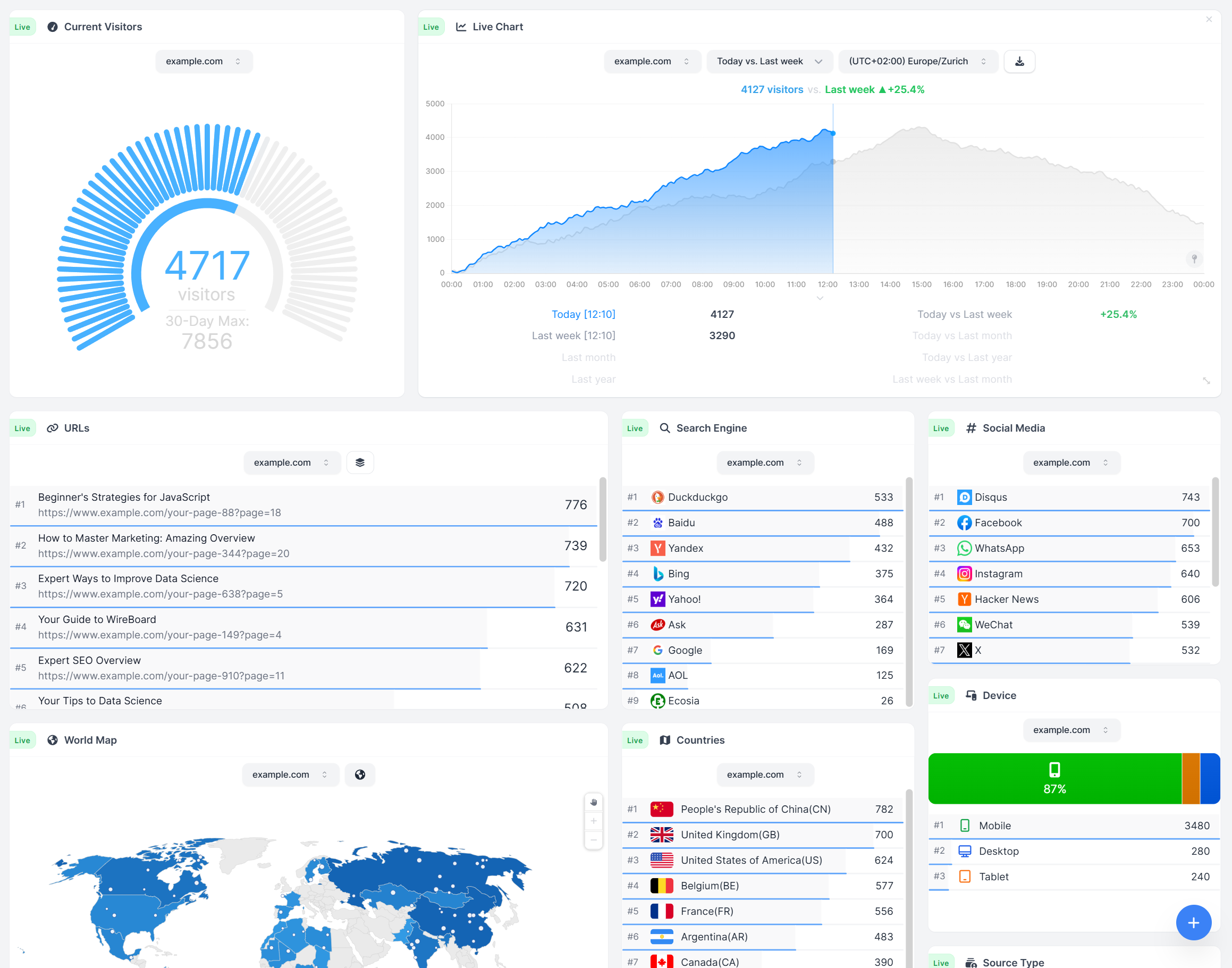
WireBoard is built for question one. Two hero widgets lead: a live count of concurrent visitors on the site right now, and a live view of which pages they are reading. Behind those two sit the world map, traffic sources, device breakdown, real-time funnels, and the rest of the 20+ real-time widgets. Around them, historical reports cover date-range stats, period-vs-period comparisons, top URLs, URL Explorer, visitor activity heatmap, goals with revenue per tier, custom events with UTM auto-capture, and the SEO suite (SERP volatility, Google update timeline, per-country holiday overlay).
Question two: why did that one user behave that way on that specific page? Why did the visitor rage-click on the pricing toggle. Where did their eye scroll on the long-form article. Whether the form was abandoned because of the third field or the email validation. What that user actually typed into the on-page feedback widget.
Hotjar is built for question two. Heatmaps show aggregate click, tap, move, and scroll patterns on a single page. Session recordings replay individual visitor sessions, with rage-click flags, u-turn detection, and (in their 2025 Hotjar Sense layer) AI-tagged friction signals. Surveys and feedback widgets ask visitors directly. Funnels link up to ten steps so you can see where users dropped off and replay the sessions that did. None of this gives you the live aggregate-traffic picture from question one. All of it is sharper at the page-and-user level than anything WireBoard does.
The reader who tries to use one tool for both questions ends up with the wrong shape of dashboard.
Where the two products actually overlap
The overlap is narrower than the search results suggest, but it is real. Four places where WireBoard and Hotjar touch the same ground.
Funnels. Both products ship funnels. WireBoard's funnels combine sessions, pageviews, and events, and they update in real time as visitors flow through them. Hotjar's funnels accept up to ten steps based on pageviews, element clicks, or events, with conversion-over-time views, segment comparisons, and the option to save the funnel into a dashboard. The data underneath each is different: WireBoard's funnels run on aggregate analytics events; Hotjar's run on session-captured events that can be replayed individually after the fact. Same word, different mechanic.
Traffic source visibility. WireBoard ships traffic sources, UTM auto-capture, and source breakdowns as headline reporting widgets. Hotjar lets you filter recordings, heatmaps, funnels, trends, and dashboards by traffic channel (referrer URL or UTM parameters), but the source view is a filter on its session data, not a dedicated reporting surface.
Dashboards. Both products have a dashboarding layer. WireBoard's dashboards are 60+ widgets, drag-and-drop, multiple boards per site, three themes (Light, Dark, Future); the canvas is the main work surface. Hotjar's dashboards collect trends, funnels, feedback data, and KPIs from across its products into one view, with multiple views per funnel and side-by-side segment comparison. Both are real dashboards. The widget vocabulary and the question they answer differ.
Custom events. Both have a one-call JavaScript event API. WireBoard's wireboard.event({ category, action, label, value }) accepts custom tags that slice every chart in a click. Hotjar's events feed targeting for recordings, heatmaps, funnels, and trends. Different downstream views, same trigger primitive.
Outside those four areas, the two products do not overlap. Hotjar does not stream live visitor counts. WireBoard does not record sessions, draw heatmaps, or ship survey widgets.
Three things Hotjar does that WireBoard does not
The gap section, in WireBoard's direction. If you need any of these and you have no plausible workaround, you need Hotjar or a similar behavior analytics tool.
1. Heatmaps. Click, tap, scroll, and movement heatmaps on individual pages. They show where attention lands and where it dies.
2. Session recordings. Playback of individual visitor sessions, with rage-click detection, u-turn detection, and friction signals. Hotjar's 2025 AI layer (Hotjar Sense) flags some of these automatically.
3. Surveys, feedback widgets, and interview recruitment. Hotjar's Ask product covers on-page surveys, in-session feedback widgets, and NPS. The separate Engage product handles user-interview recruitment and scheduling.
If your day-to-day question is "why," Hotjar's tooling here is mature.
Three things WireBoard does that Hotjar does not
The reverse list. None of these is on Hotjar's product page because Hotjar is not in this space.
1. Live streaming web analytics. WireBoard's live visitor counter, live view of pages being read, world map, traffic sources, device breakdown, and real-time funnels update as events arrive. Hotjar's session captures and heatmaps are built on its own session pipeline; they are not the live traffic dashboard a site owner opens during a launch or a viral moment.
2. Multi-site live aggregation. WireBoard aggregates live traffic across any selection of your sites into a single widget. The same widget covers one site or fifty. Hotjar separates each site (each "site" in Hotjar has its own session quota); a multi-site live view is not part of the product. For an agency, a publisher with multiple titles, or a company running a main site and several microsites, this is the daily-use feature.
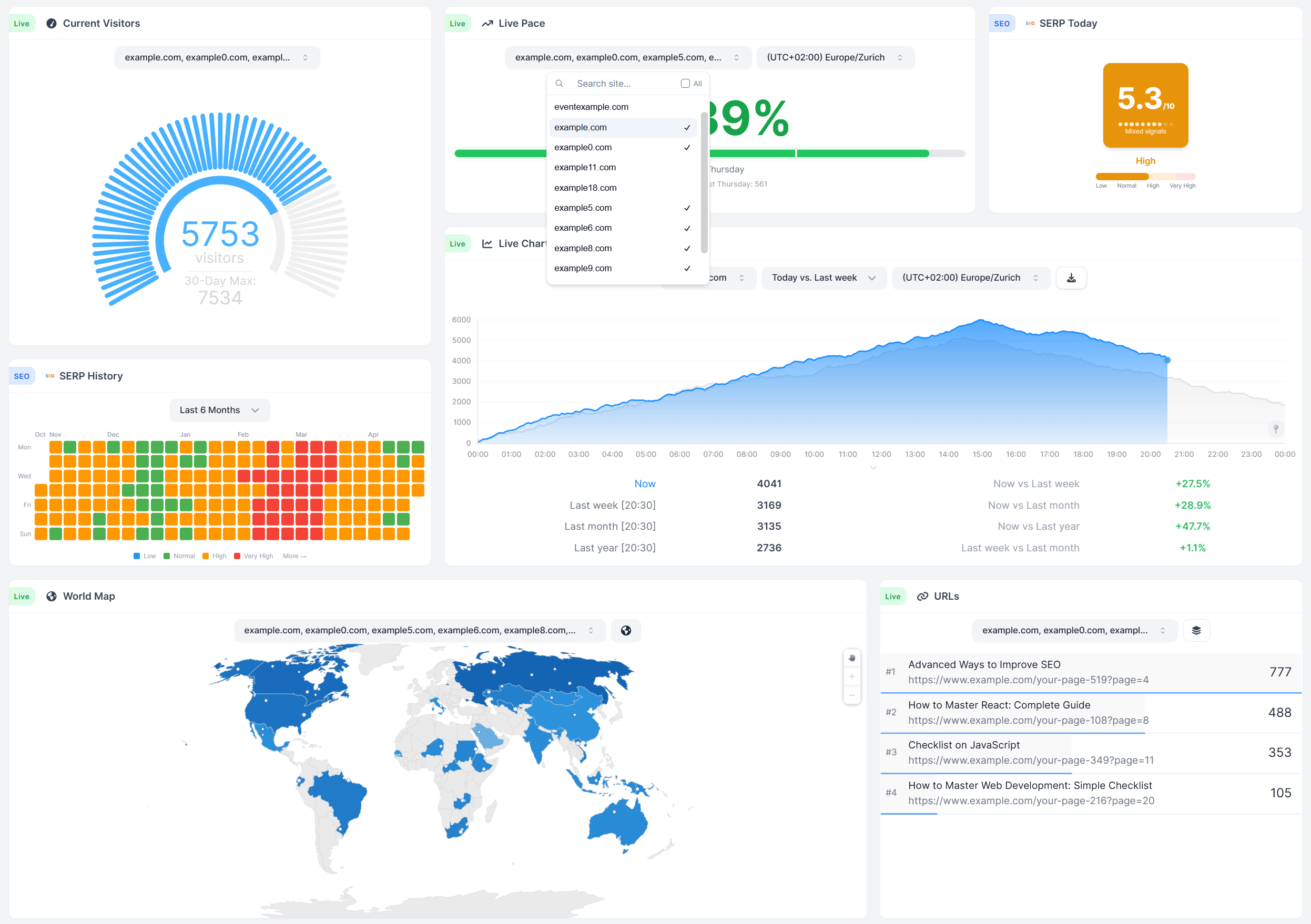
3. SEO suite: SERP volatility and Google update tracking. WireBoard's SEO dashboards (SERP Volatility, SERP Heatmap, Google Core and Spam Updates timeline, per-country holiday overlay) sit next to your traffic charts. On an algorithm rollout day, you open one tab. Hotjar does not track Google's behavior; it tracks user behavior on your site.
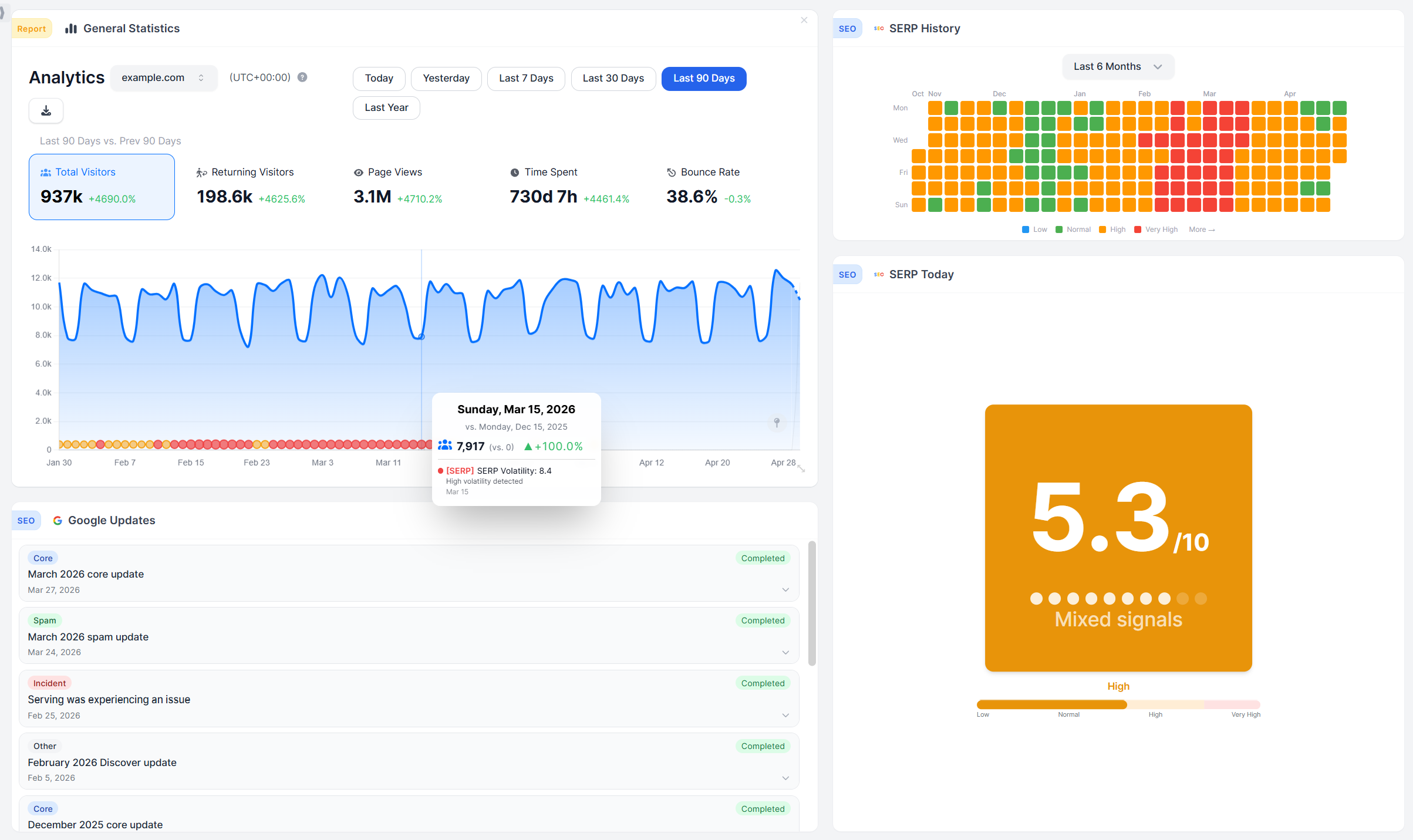
Beyond those three, WireBoard ships a customizable dashboard surface (60+ widgets, drag-and-drop, three themes, multiple dashboards per site), goals with revenue per plan tier, scheduled CSV / JSON / XLS / XLSX / ODS exports to S3, FTP, or SFTP, public shareable dashboards, embed tokens for client portals, Streamer Mode that blurs your own URLs for safe demos, and a two-minute, one-script-tag setup with first-class WordPress, Laravel, Shopify, Wix, Squarespace, Webflow, and Next.js support.
A public REST + Live API, with official SDKs and an MCP server. WireBoard ships a public API at api.wireboard.io: a set of REST endpoints (account, sites, aggregates, time-series, breakdowns, URL explorer, custom events) plus a Live Server-Sent Events stream covering 20 categories of visitor activity in real time. The REST API is on every plan, including free (with a 30-day history cap on free, unlimited within retention on paid); the Live API is on every paid plan. Official @wireboard/api (JS/TS/Node) and wireboard-api (Python) SDKs are included, plus a @wireboard/mcp server so Claude, Cursor, and other LLM agents can query your analytics conversationally. Hotjar's public API surface is centered on event ingestion and org management; pulling your aggregate analytics out for your own product, dashboard, or alerting pipeline is a WireBoard side of the comparison.
Is WireBoard a Hotjar alternative? Sort of.
The Hotjar alternative question splits clean down the middle. If your day is replaying individual sessions and chasing the rage-clicks behind a checkout drop-off, WireBoard is not a Hotjar replacement; the two tools answer different questions and many teams run both, paying Hotjar on a checkout or paywall and using WireBoard for the rest of the site.
If you signed up for Hotjar because you wanted to watch live traffic, build your own dashboards across sixty-plus widgets, manage several sites in one streaming view, or track SERP volatility next to your visitor charts, then yes: WireBoard is the Hotjar alternative for that part of the job, and Hotjar can be the one to drop on those pages. WireBoard's lead is live data, the visitor counter, the world map, traffic sources, and the event feed all stream the moment a hit lands.
A permanent Free Plan covers 50,000 page views, 2 sites, 3 dashboards, and every feature ships on every paid tier, no upgrade gate on funnels, revenue tracking, or multi-site aggregation. The honest version of the question is which job is bigger for you.
Should you trust this comparison?
"I run WireBoard. I've used Hotjar myself. The question I get asked most by buyers is whether one product replaces the other. The answer most of the time is no, and pretending otherwise would waste your money." Patrick Wunderlin, founder, WireBoard
Every WireBoard feature claim in this post is grounded in WireBoard's public features and docs pages, linked at the bottom. Every Hotjar feature claim is grounded in Hotjar's own product, pricing, and documentation pages, or in Contentsquare's published positioning following the merger. No claim about either product is inferred from a third-party review.
Typical WireBoard customers are publishers and content sites: Robert Farrington runs The College Investor (long-form personal-finance content), Barry Schwartz runs Search Engine Roundtable (SEO news), Morten Vadskær runs puck24.dk (Danish ice-hockey news). They need live traffic visibility, SERP volatility and Google update tracking, and multi-site rollups. For sites like these, paying for behavior tooling on every page rarely makes sense; it earns its keep on a checkout or a paywall.
How the pricing actually plays out
Prices below were recorded from each company's published pricing page in May 2026. Both Hotjar and WireBoard adjust pricing periodically. Before making a buying decision, verify current rates on the Hotjar pricing page and the WireBoard pricing page.
Two different pricing philosophies, two different units of measurement.
Hotjar prices by sessions captured per day, and the price is per product (Observe for heatmaps and recordings, Ask for surveys, Engage for interviews), with a unified Contentsquare-platform bundle being rolled out to replace the per-product model over 2025 and 2026. WireBoard prices by page views per month and bundles every feature into every plan.
Hotjar's Observe tiers (heatmaps + recordings)
Plan | Monthly billing | Yearly billing | Sessions captured per day | Notes |
|---|---|---|---|---|
Observe Basic (Free) | $0 | $0 | 35 | 12-month data retention |
Observe Plus | $39/mo | $32/mo | 100 | Unlocks Events API |
Observe Business | $99/mo | $80/mo | 500 | Higher daily cap |
Observe Scale | $213/mo | $171/mo | 1,500 | Higher daily cap |
Ask (surveys + feedback) is priced separately, starting at $48/mo annual ($59/mo monthly) on its paid tier. Engage (interviews) is priced significantly higher. Yearly billing saves roughly 18 to 20 percent. Once you exceed your daily session cap, Hotjar samples your traffic for the rest of the day; collection resumes the next day, no overage fee, but the sampled portion is lost.
WireBoard's tiers (one product, every feature, every plan)
Plan | Monthly | Yearly | Page views/mo | Sites | Dashboards | Team seats | History |
|---|---|---|---|---|---|---|---|
Free Plan | $0 | $0 | 50,000 | 2 | 3 | 1 | 30 days |
Micro | $9 | $90/yr | 100,000 | 50 | 100 | 3 | 3 years |
Small | $19 | $190/yr | 250,000 | 50 | 100 | 5 | 3 years |
Medium | $24 | $240/yr | 500,000 | 50 | 100 | 10 | 3 years |
Large | $49 | $490/yr | 1,000,000 | 50 | 100 | 15 | 3 years |
Extra Large | $99 | $990/yr | 3,000,000 | 50 | 100 | 20 | 3 years |
Pro | $199 | $1,990/yr | 6,000,000 | 50 | 100 | 30 | 3 years |
Pro Plus | $399 | $3,990/yr | 12,000,000 | 100 | 200 | 50 | 3 years |
Yearly billing saves about 17 percent (two months free). VAT added at checkout based on buyer location. No credit card on the Free Plan.
The two units do not convert cleanly
A "session" in Hotjar is a captured visitor session: one user, one or more pages, bundled together for replay and heatmap aggregation. A "page view" in WireBoard is a single page load. A visitor who reads three pages is one Hotjar session and three WireBoard page views. The two units measure different things, and there is no clean multiplier between them. The pricing comparison that follows respects that.
What does compare cleanly: at the entry paid tier, Hotjar Observe Plus ($39/mo monthly, $32/mo yearly) captures up to 100 sessions per day and unlocks heatmaps and recordings only. WireBoard Micro ($9/mo monthly, $90/yr yearly) covers 100,000 page views per month across up to 50 sites with every WireBoard feature included. They do not solve the same problem at the same price; that is the whole point of this post.
The running-both math (for the overlap-zone reader)
If you decide you want both a live traffic dashboard and Hotjar's heatmaps and recordings on a site doing roughly a million page views a month, a representative monthly bill is WireBoard Large ($49/mo) plus Hotjar Observe Business ($99/mo), for $148/mo. On annual billing that drops to about $130/mo. Whether the Hotjar half is worth it depends on how often you actually replay sessions or read survey responses. If you do not, drop it to Observe Plus ($39/mo) on the highest-traffic page only, or skip Hotjar for now and add it back when a specific question makes you want it.
Try both on your own data
The right way to decide is to install each one on a real site and compare side by side.
Install WireBoard. Sign up at wireboard.io/register, paste the one script tag (or use the WordPress plugin), and the default-template dashboard populates the moment the first visitor arrives. Use the live counter, the live pages widget, and the world map during a launch, a campaign send, or any normal afternoon, and see whether the live traffic view is what your current analytics tool has been missing.
Install Hotjar Observe. Sign up at hotjar.com, paste the tracking code, and Hotjar starts capturing sessions and building heatmaps within the daily cap. Pick one or two key pages (pricing, checkout, signup, a long-form article) and look at the heatmap and the session recordings after a few days of traffic.
Decide which question matters more day to day. If you stayed inside WireBoard, you want a real-time analytics tool and the behavior side is optional. If you stayed inside Hotjar, you want a behavior analytics tool and your existing analytics is good enough. If you opened both daily, you want both, and the pricing math above is the budget conversation.
You don't have to commit while you do this. Both products have free tiers and both let you cancel before any payment runs.
Pros and cons at a glance
WireBoard | Hotjar | |
|---|---|---|
+ | ✅ True streaming real-time | ✅ Heatmaps, the original |
− | ❌ No heatmaps | ❌ Not built for live traffic |
The bottom line
Hotjar is the right pick in three narrow situations: heatmaps or session recordings are central to how you work, on-page surveys and feedback widgets are part of your research stack, or you need user-interview recruitment built into the same tool.
For everyone else trying to answer "what is happening on my site right now and how is it trending," WireBoard wins. Streaming live widgets, 60+ customizable widgets and drag-and-drop dashboards, multi-site live aggregation, SERP volatility and Google update tracking, real-time funnels, goals with revenue per tier, every feature on every plan. No tier-gated funnels, no tier-gated revenue tracking, no asterisks. And if you want both, run them side by side. They were designed to live next to each other.
Start watching your traffic live with WireBoard. 50,000 page views per month, 2 websites, 3 dashboards, every feature included. No credit card. No trial period. No catch.
Sources
WireBoard
Hotjar (where the claims about their product are grounded)