


Which should you pick: WireBoard or Umami?
Umami's marketing leans into open source, MIT licensing, and one simple paid tier. WireBoard leans into a managed in-house pipeline, streaming live data, and a dashboard system you build the way you'd build a control panel. Same problem, opposite muscles.
Pick Umami if self-hosting on your own servers matters to you, if you debug stuck visitors by watching their session in your analytics tool, if your traffic is heavy on custom events and Umami's per-event pricing wins your math, or if contributing to and forking an MIT-licensed codebase is the workflow you actually want.
Pick WireBoard if you watch traffic live during launches, ad runs, or Google algorithm-update days; you keep slicing your data across multiple dimensions at once and want that slicing to be one click instead of a filter modal; you operate several sites and want them on one dashboard; you want to arrange the dashboard the way you actually work instead of accepting a fixed layout; or you want SERP volatility and Google algorithm-update tracking next to your analytics on the same screen.
The rest of the post: the side-by-side scoreboard, the four product decisions where the two teams pulled apart, where Umami beats WireBoard, where WireBoard pulls ahead, the pricing math, and a side-by-side install you can run on your own site to settle it firsthand.
At a glance
| WireBoard | Umami | |
|---|---|---|
| Real-time | Streaming live widgets, real-time funnels, live event feed | 30-minute lookback window, polling-based |
| Dashboards | 60+ widgets, multiple per site, three themes, populated default template | Boards (added 2025), row/column canvas, single-website or "Mixed" |
| Multi-site live aggregation | Yes, in a single widget, streaming | Mixed Boards combine sites; same 30-minute window |
| SEO suite (SERP volatility, Google updates) | Included on every plan | Not offered |
| Annotations layer on time-axis charts | Four built-in layers + per-user notes | Not offered |
| Session replay | Not offered (not on the roadmap) | Yes, configurable masking, 30-day retention |
| Funnels (real-time) | Every plan, flexible order | Every plan, URL or event steps |
| Revenue tracking + custom properties | Every plan, including free | Every plan |
| Free plan | Permanent, every feature, 50k PV/mo, 30-day history | Permanent, 100k events/mo, 3 sites, 6-month retention |
| Price for 1M monthly volume | $49/mo (Large), 3-year history | $20/mo (Pro), 2-year retention |
| Capability included at that price | Multi-site live, SERP + Google-update tracking, every feature, 15 seats | Core analytics, funnels, session replay |
| Open source / self-hostable | No | Yes (MIT), unlimited retention self-hosted |
| Read-only public API | Yes, REST + Live SSE, official JS + Python SDKs, MCP server | Yes (Cloud only, gated from self-hosted edition) |
| WordPress plugin | First-party, dashboards inside wp-admin | Community-built only |
| Cookieless mode | Optional toggle, off by default for accuracy | Always on, no toggle |
Stop comparing on cookies. That's not the real fork.
Most Umami-vs-anything posts open with cookies. Cookieless tracking is Umami's marquee marketing line, framed by Umami as removing the cookie-consent friction altogether. It is a fine line. It just is not where the buying decision lives.
WireBoard runs a cookieless mode too. One toggle in your site settings drops you into Legitimate Interest. The capability gap on cookies is small. Both products position themselves as removing the cookie-consent step in EU jurisdictions; whether that holds for any specific deployment depends on what data is collected and how the legal team interprets it. Both also clear Schrems II without sending data to the US. Umami offers a Germany region on its cloud (and self-hosting goes wherever you put it); WireBoard's full pipeline runs on EU infrastructure operated by SwissOps Ltd.
If cookies are how you are picking between Umami and WireBoard, you are picking between two right answers. The actual differences sit downstream of that, in four product decisions. They are what should drive the call.
Four product calls Umami went the other way on
Umami's team and WireBoard's team are solving the same job with different muscles. Four places where they pulled in opposite directions:
Fork one: "real-time" as the last thirty minutes, or as streaming live?
Umami's real-time API returns, in their docs' wording, "realtime stats within the last 30 minutes." That's their documented design choice for real-time: an aggregation window covering the last half hour, not a stream of individual events as they land.
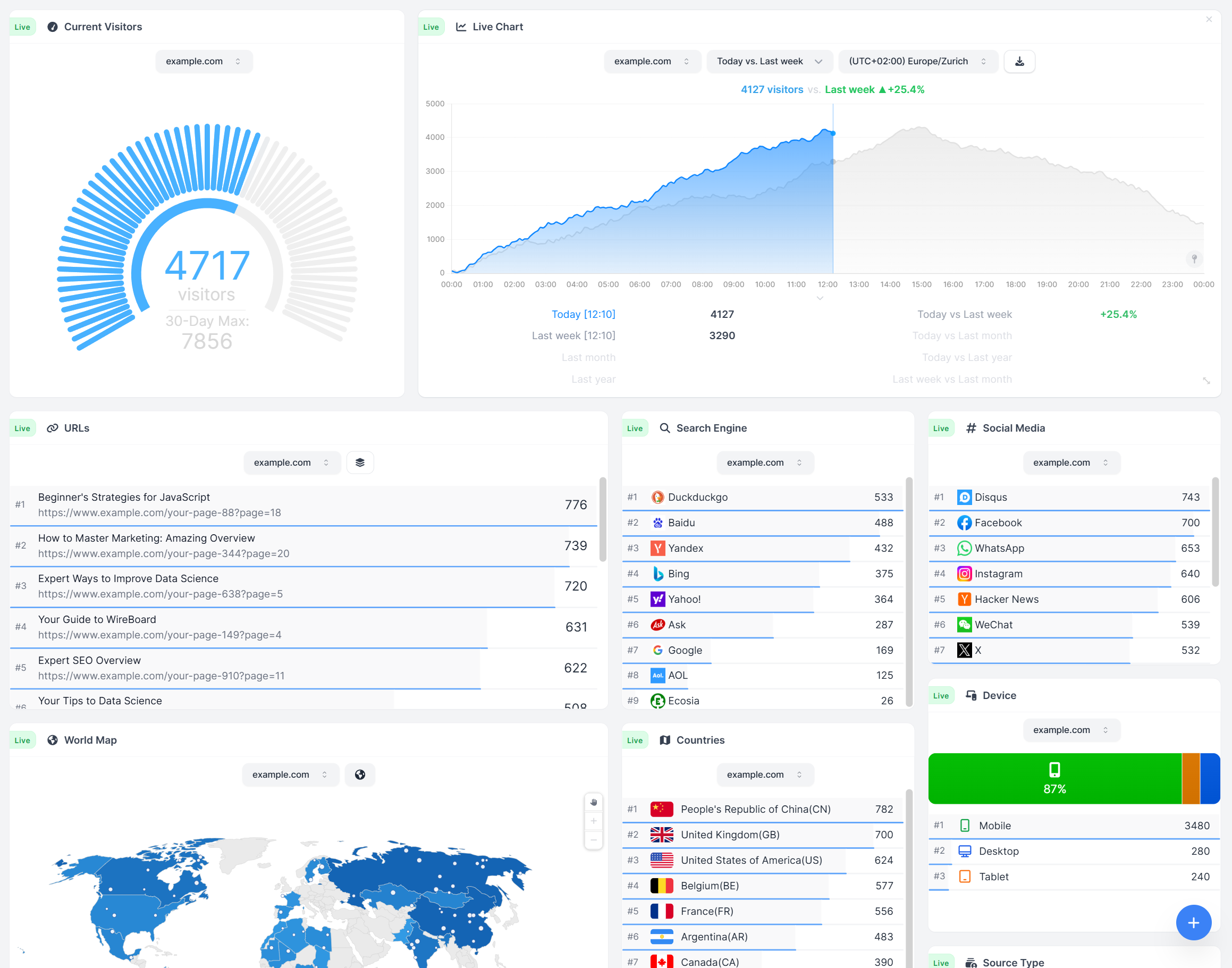
WireBoard's live widgets stream. The live visitor counter, the world map, the referrer feed, the UTM-campaign breakdown, the device and browser splits, the live event feed, the live funnel, and the live user journey all update the moment a hit lands. The live counter covers a full day of concurrent activity, not a thirty-minute slice. Historical reports (date-range trends, top URLs, period-vs-period comparisons) work on stored data the way you would expect.
If you check analytics weekly before a leadership meeting, this gap is invisible. If you ship product on a Tuesday, watch a campaign go live Friday afternoon, or spend Google-update day staring at SERP volatility, the gap is the whole point. We built WireBoard's pipeline in-house specifically because you cannot bolt streaming onto a third-party ingestion service after the fact.
Fork two: a custom-board feature added on top, or a customizable dashboard system from sign-up?
For most of its history, Umami had one fixed dashboard per website. Version 3.1 in 2025 introduced Boards: a row-and-column canvas where you place chart, table, and metric components, then bind the board to a single site or to a "Mixed" board across several. Boards are a real and welcome upgrade. They are also less than a year old.
WireBoard's dashboard system is the product, not an addition. Sixty-plus widgets, three themes, multiple dashboards per site, and a fully populated default-template board the moment you sign up. You don't decide whether to customize. You decide what to add: a live operations board for monitoring, a weekly review board for the team, a client-facing board for demos. The same data, three different views.
In plain terms: Umami's Boards are a recent addition still filling out. WireBoard's dashboard system was the foundation everything else was built around. If breadth of widgets and depth of multi-board organization matter to you, the edge sits with WireBoard today.
Fork three: MIT-licensed and self-hostable, or in-house managed pipeline?
Umami's source is MIT-licensed and self-hostable. Pull the repo, run it on a small VPS, audit the code, modify what you need, never pay anyone. The MIT license is even friendlier than AGPL: you can embed Umami's code inside commercial products without inheriting copyleft obligations. If "the software runs on servers we operate" is non-negotiable for your security or sovereignty team, this is the call.
One caveat for self-hosters: a small number of features sit only on Umami Cloud. The read-only public API is the most-cited example.
WireBoard goes the other way deliberately. We're a managed service, closed-source, with the entire data path (collection, storage, processing, dashboards) operated by us on EU infrastructure. That is how we ship streaming as the default rather than as a paid add-on. Trade-off: you cannot run WireBoard on your own hardware. You are trusting SwissOps Ltd. to operate the platform. If self-hosting is a requirement, Umami wins this fork outright.
Fork four: cookieless-only, or cookies-by-default with a one-switch cookieless mode?
This is the fork most reviews invert, so it is worth being precise.
Umami runs cookie-free always. There is no toggle. The tracker identifies returning visitors by hashing hostname plus user-agent with a daily-rotating salt that resets every twenty-four hours. Umami's marketing positions this as removing the cookie-consent banner requirement. Trade-off on the accuracy side: a visitor who returns the next day looks like a brand-new session because the salt has rotated, which costs accuracy on returning-visitor and engagement-depth metrics.
WireBoard runs cookies on by default for the most accurate session, returning-visitor, and journey tracking. One toggle flips the entire site to cookieless mode under Legitimate Interest. WireBoard's marketing positions the cookieless mode as not requiring a consent banner either.
The shape of the disagreement: Umami offers one mode, simple. WireBoard offers two modes, with the more accurate one selected by default. In capability terms, WireBoard is the strict superset. The case for Umami's "one mode only" is legal-narrative simplicity, "we use a tool that has no cookie setting; conversation closed." That is a valid reason for some legal teams. It is not a capability case.
Where Umami pulls ahead today
The list of places Umami beats WireBoard, kept to facts you can point at:
Self-hosting under MIT. Already covered. Real, structural advantage. The MIT license is a softer touch than AGPL for downstream commercial use.
Session replay. Umami v3.1 ships session replay, with configurable masking levels (moderate by default, strict if you want all text masked too) and a thirty-day retention window. WireBoard does not ship session replay today, and it is not on our roadmap. If watching the recording of a stuck visitor is part of your debugging loop, this is Umami.
Custom-reporting hackability via open source. WireBoard now ships a public REST + Live SSE API at api.wireboard.io, with official JavaScript and Python SDKs and an MCP server for Claude Desktop, Cursor, and other LLM agents, so the read-API gap that used to sit here is closed. Where Umami still pulls ahead is the codebase itself: open source plus the Cloud public API means a developer on your team can fork the analytics engine, not just call it. WireBoard ships scheduled email reports today; first-party Slack reporting and configurable spike alerts are on the roadmap but not shipped. If you want to modify how the tool works under the hood rather than build around it, Umami's open surface is still friendlier.
Open-source community size. Thirty-six thousand-plus GitHub stars, mature self-hosting recipes for Vercel, DigitalOcean, Hetzner, Ubuntu VPS, and most cloud providers. If "size of the contributor and self-hosting community" tips your call, Umami is the larger one.
Per-event pricing at high volume. Umami Cloud's headline is twenty dollars per month for one million events, then two cents per thousand events above that. At raw volume, the math is simple and goes Umami's way. We will return to where the math flips on capability per dollar.
Five advantages that show up in the products themselves, not in the marketing.
Where WireBoard pulls ahead
The inverse list, kept to facts visible in both products' public documentation:
Streaming live widgets across the dashboard. Not just a "current visitors" tile. The live visitor counter, world map, referrer feed, UTM-campaign feed, device and browser splits, live event feed, live funnel, and live user journey all update the moment a hit lands. Historical reports (date-range trends, top URLs, period-vs-period) work on stored data the way you would expect.
Multi-site live aggregation in one widget. Umami's Mixed Boards combine components across sites, but the live aggregation reads from the same thirty-minute real-time window as the rest of the API. WireBoard's multi-site widget streams aggregated live traffic across whatever set of sites you point at it. For agencies running multiple clients, this is the single biggest functional gap.
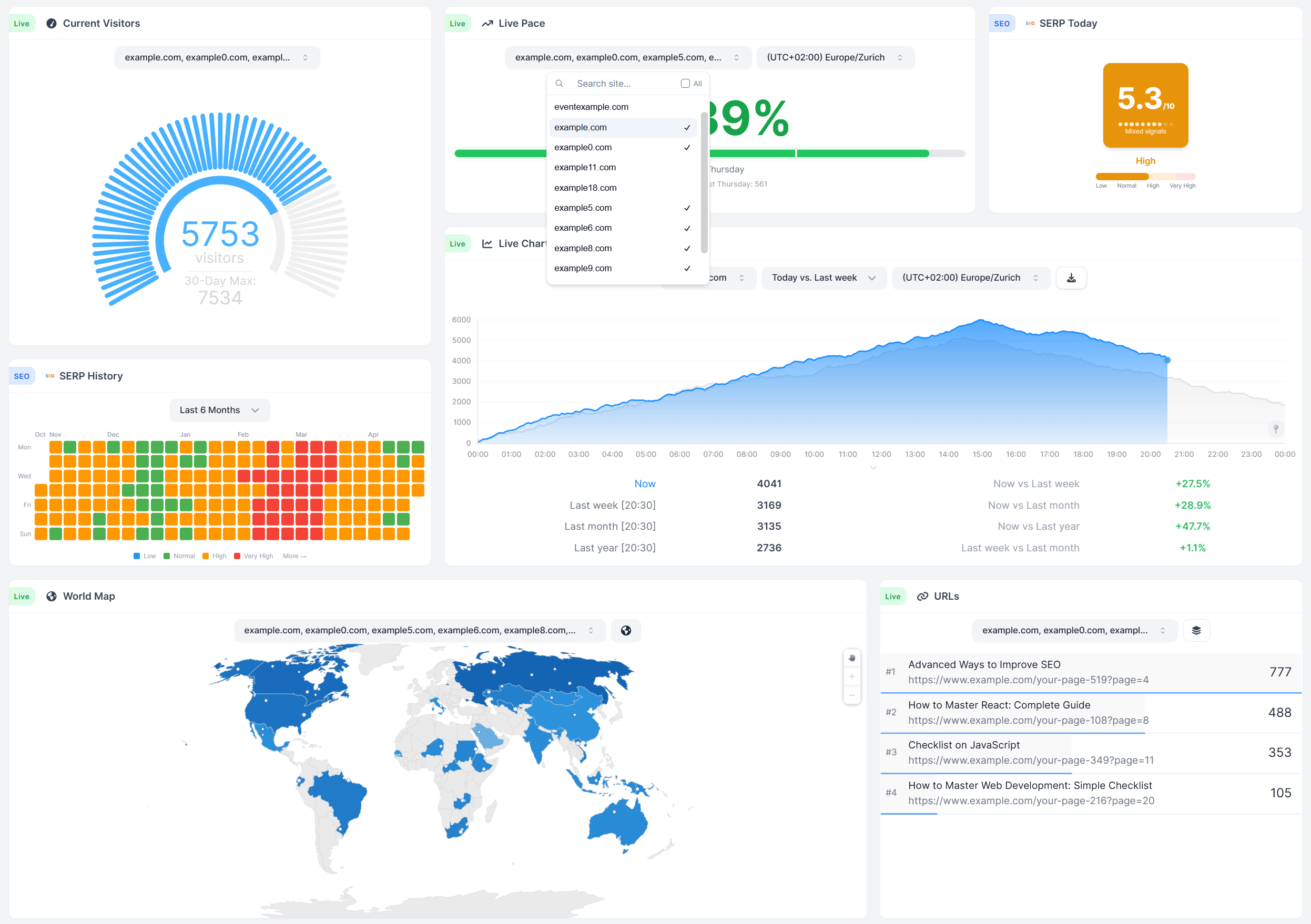
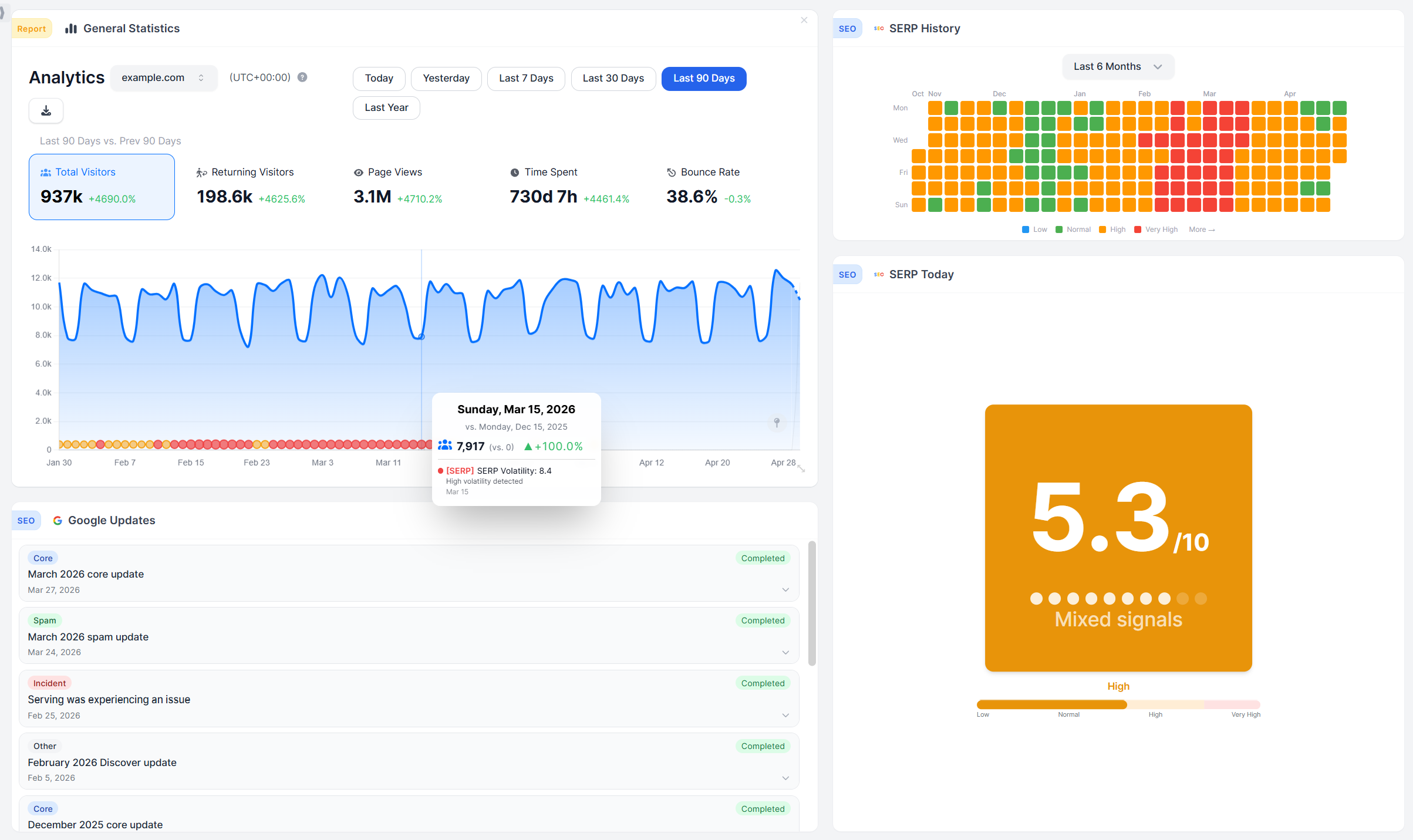
An integrated SEO suite. SERP Volatility live dashboard, Google Core and Spam Updates timeline, per-country holiday annotation overlay. Umami does not ship anything in this category. On algorithm-update days, that gap is the difference between a thirty-second briefing and an hour of guessing.
Sixty-plus drag-and-drop widgets, multiple dashboards per site, three themes. Umami's Boards are a recent addition with a smaller component set; WireBoard's dashboard system carries broader widget coverage and deeper multi-board organization today.
An annotation layer on every chart with a time axis. Layers for My Events, Google Updates, SERP Volatility, and Public Holidays, plus user-specific notes, all painted on top of whatever time series you are looking at. Umami offers text blocks on Boards, but nothing that ties a labelled event to a calendar date on a chart.
Streamer Mode and Shift+C screenshots. Blur your domains and URLs for live demos and client screen shares; one keystroke saves a PNG of any board.
Per-graph and per-site timezone. Umami uses one timezone per account.
A public API with a live event stream. WireBoard's API at api.wireboard.io exposes a REST surface (account, sites, aggregate, time-series, breakdowns, URL explorer, custom events) plus a Server-Sent Events stream that delivers 20 categories of visitor activity the moment they land. Official JavaScript and Python SDKs handle auth and reconnection, and an MCP server lets Claude Desktop, Cursor, and other LLM agents query your analytics in conversation. Umami's "realtime" API returns an aggregated thirty-minute window over REST polling; there is no live event stream to subscribe to.
Goals with revenue per event property value. Conversion count, conversion rate, and revenue per goal, broken down by plan tier, country, device, browser, or source, with a trend-over-time view.
A first-party WordPress plugin. Dashboards inside wp-admin, magic-link sign-in for editors, one-click setup. Umami has a community-built WordPress plugin; the official Umami integrations doc lists VuePress, Gatsby, Nuxt, Craft CMS, and Docusaurus, not WordPress.
Three-year retention on every paid plan. Umami's free Hobby tier is six months, Pro is two years; WireBoard gives you three years from the nine-dollar Micro plan upward.
Why teams switch to WireBoard as an Umami alternative
Plenty of teams end up here after working with Umami long enough to know what they want next. WireBoard's lead is live data: the visitor counter, the world map, and the event feed all stream the moment a hit lands. When a tweet sends traffic, you see it arrive. Around that streaming core, WireBoard ships sixty-plus drag-and-drop widgets, multiple boards per site, three themes, and a populated default template the minute you sign up.
Need to read several sites at once? One live widget aggregates them, streaming. Watching for a Google update on a turbulent SERP morning? SERP volatility and the core-and-spam-update timeline sit right next to your traffic. Need revenue broken out by plan tier, country, or source? Goals do that with a trend chart.
Every paid feature is unlocked on every paid tier, and the permanent Free Plan covers 50,000 pageviews on two sites and three boards. If that's the surface you've been wanting, WireBoard is the Umami alternative built for it.
Should you trust this comparison?
Worth asking. Here is the disclosure:
I run WireBoard. I have used Umami, spoken to several prospects who chose it over us, and re-read their release notes from v2 forward enough times to know the changelog by feel. This piece is the answer I keep wanting to send when somebody asks me how the two tools actually differ in practice. Where Umami is the stronger pick, I say so. Where WireBoard is, I say that too, with the sources to back it.
Two more weights for the scale:
Where the claims come from. Every claim about Umami points at their public documentation, GitHub releases, or pricing page, all linked at the bottom. Every claim about WireBoard reflects what we ship today. Roadmap items (Slack-native reporting, configurable traffic-spike alerts) are flagged with that exact framing.
Who picks WireBoard. Barry Schwartz at Search Engine Roundtable covers Google updates daily and watches SERP volatility live. Robert Farrington at The College Investor runs a publishing operation with sustained traffic. Jon James at TeamGreet runs a SaaS where conversion math sits on the dashboard. None of them stumbled into us. They picked WireBoard for specific reasons that line up with what is in this post. If your shape of work overlaps with theirs, that signal is stronger than my opinion.
How the pricing actually plays out
Prices below were recorded from each company's published pricing page in May 2026. Both Umami and WireBoard adjust pricing periodically. Before making a buying decision, verify current rates on the Umami pricing page and the WireBoard pricing page.
Two pricing models, two philosophies. Umami sells volume: one paid tier, per-event overage above it, every feature included. WireBoard sells capacity for capability: pageviews, sites, dashboards, seats, retention, all bundled into nine plans, every feature on every paid tier.
Umami's tiers
Umami publishes two cloud tiers plus the always-free self-hosted edition.
| Umami plan | Price | Events/mo | Retention | Notes |
|---|---|---|---|---|
| Self-hosted (MIT) | Free | Unlimited | Unlimited | Public API not included |
| Hobby | $0 | 100,000 | 6 months | Up to 3 sites, free forever |
| Pro | $20/mo | 1,000,000 | 2 years | $0.00002 per event above 1M |
Above one million events per month, Umami charges roughly twenty dollars for each additional million.
WireBoard's tiers
WireBoard publishes nine plans starting at zero dollars forever. Yearly billing trims about seventeen percent (two months free), and every paid tier includes every feature.
| WireBoard plan | Monthly | Pageviews/mo | Sites | Dashboards | Team seats | History |
|---|---|---|---|---|---|---|
| Free Plan | $0 | 50,000 | 2 | 3 | 1 | 30 days |
| Micro | $9 | 100,000 | 50 | 100 | 3 | 3 years |
| Small | $19 | 250,000 | 50 | 100 | 5 | 3 years |
| Medium | $24 | 500,000 | 50 | 100 | 10 | 3 years |
| Large | $49 | 1,000,000 | 50 | 100 | 15 | 3 years |
| Extra Large | $99 | 3,000,000 | 50 | 100 | 20 | 3 years |
| Pro | $199 | 6,000,000 | 50 | 100 | 30 | 3 years |
| Pro Plus | $399 | 12,000,000 | 100 | 200 | 50 | 3 years |
| Enterprise | Custom | Custom | Unlimited | Unlimited | Unlimited | Custom |
Same volume, different value
Both products count any tracked hit toward the monthly quota: pageviews and custom events alike. WireBoard markets the quota as "page views" and Umami markets it as "events," but the underlying counting is the same. So a million tracked hits a month on either product corresponds to the same row below.
| Volume | WireBoard | Umami Cloud | Where the math lands |
|---|---|---|---|
| 100k / month | $9/mo (Micro), 50 sites, 3-yr history | Free (Hobby), 3 sites, 6-mo retention | Umami wins on price; WireBoard wins on retention and site count |
| 1M / month | $49/mo (Large), 50 sites, 3-yr history, SERP + Google-update tracking, multi-site live, 15 seats | $20/mo (Pro), 2-yr retention | Umami wins on price; WireBoard wins on capability per dollar |
| 6M / month | $199/mo (Pro), 30 seats, 3-yr history | ~$120/mo (base + overage) | Umami wins on price |
| 12M / month | $399/mo (Pro Plus), 100 sites, 50 seats, 3-yr history | ~$240/mo (base + overage) | Umami wins on price |
I am not going to pretend WireBoard wins on raw price at volume. It does not. The honest framing: at pure event volume, Umami's math is the cheaper one and that is hard to beat. At capability per dollar, WireBoard is. For the extra spend you get streaming live widgets instead of a thirty-minute lookback, customizable dashboards with sixty-plus widgets and multiple boards per site, multi-site live aggregation in a single widget, the SEO suite (SERP volatility, Google updates, holiday overlay), one-click cross-filter slicing of every report, three-year data retention instead of two, and fifteen team seats. Two different things being sold.
Three differences that move the buying decision
- Volume vs. capability. A million-event site on Umami pays twenty dollars for the analytics, funnels, and replay it ships. The same site on WireBoard pays forty-nine dollars for streaming live widgets, customizable dashboards with sixty-plus widgets, multi-site live aggregation, SERP volatility and Google update tracking, one-click cross-filter slicing, three-year retention, and fifteen team seats (no replay). The question is not "which is cheaper." It is "which set of capabilities matches what I actually do every week."
- Two free tiers, two shapes. WireBoard's free plan: 50,000 pageviews, 2 sites, 3 dashboards, every feature included, retention pulled back to thirty days. Umami's free Hobby tier: 100,000 events, up to 3 sites, every feature, retention pulled back to six months. Pick the shape that matches your workload.
- WireBoard never gates features. Funnels, revenue tracking, custom events with properties, SERP volatility and Google update tracking, multi-site live aggregation, embed tokens, Streamer Mode, the public REST API: every one of them on every WireBoard tier including free (the Live SSE stream is the one paid-only piece of the API surface). Umami's gates are smaller too (the public API behind Cloud is the main one), but they are there.
Don't decide on theory. Install both.
Reading is the slow path to this answer. Try them.
Umami's Hobby tier is permanent and free. WireBoard's free plan is permanent and free. (And if you would rather not register at all, self-host Umami on a fifteen-minute VPS.) Drop the script on a real site, send some real traffic at it, and watch what happens on each.
Three things to compare side by side:
- Open both dashboards on one screen. Send a test visit, or have a teammate browse the site. Time how long until each tool shows it. The streaming-vs-thirty-minute-window difference becomes obvious in seconds.
- Pick a busy moment. Run a small ad, share the link in a high-engagement Slack, or wait for organic traffic on a high-search-volume page. Note which dashboard you would rather watch during a launch.
- Pick one real question from your week and ask each tool. "What's the bounce rate on yesterday's UTM campaign by country?" "Did Friday's deploy change anything?" "Is Google's ranking shaking today?" "Where is the funnel leaking?" Whichever dashboard answers it faster wins on your actual job, not on a generic feature shortlist.
Once you've done those three, the four forks above stop being theoretical.
Pros and cons at a glance
| WireBoard | Umami | |
|---|---|---|
| + | ✅ True real-time, streaming live ✅ 60+ widgets, fully customizable ✅ Multi-site live in one view ✅ SERP volatility + Google update tracking ✅ Public API: REST + Live SSE stream, JS/Python SDKs, MCP server ✅ Every feature on every plan, even free |
✅ Open source, self-hostable ✅ Session replay built in ✅ Lower raw cost at scale |
| − | ❌ No self-hosting ❌ No session replay ❌ Higher raw cost at scale |
❌ 30-min window, not streaming ❌ Limited dashboard customization ❌ No SERP / Google-update tracking ❌ REST API only, no live event stream ❌ Shorter retention (6mo / 2yr) ❌ No annotations on charts |
The bottom line
Umami is the right pick in three narrow situations: open-source self-hosting is non-negotiable, you need session replay, or you optimize purely on raw event cost at very high volumes.
For everyone else, WireBoard wins. Streaming live traffic the moment a hit lands. Sixty-plus widgets you arrange the way you actually work. Multi-site live aggregation in one widget. SERP volatility and Google update tracking on the same screen as your analytics. Every feature on every plan, including the permanent free tier. No tier-gated funnels, no tier-gated revenue tracking, no tier-gated multi-site, no asterisks.
Start tracking for free with WireBoard. 50,000 pageviews per month, 2 websites, 3 dashboards, every feature included. No credit card. No trial period. No catch.
Sources
WireBoard
- WireBoard homepage
- WireBoard pricing
- WireBoard features
- SERP volatility live tool
- Google Core and Spam Updates timeline
- WireBoard product timeline and changelog
- WireBoard privacy policy
- WireBoard documentation
Umami (where the claims about their product are grounded)
- Umami pricing
- Umami real-time API documentation
- Umami session replay documentation
- Umami source code on GitHub
- Umami official integrations list
EU data protection and infrastructure