


Which should you pick: WireBoard or Plausible?
Plausible and WireBoard are both serious answers to "what should I use instead of Google Analytics 4?" Both are EU-hosted. Both market themselves as GDPR compliant. Both win on privacy. But they answer two different questions, and most reviews miss the difference.
Pick Plausible if you read your traffic in a single scannable summary, or if self-hosting on your own server is non-negotiable for you.
Pick WireBoard if you watch your traffic live during launches, ad campaigns or Google update days, if you operate more than one site, if you keep arranging your dashboard around the way you actually work, or if you track SERP volatility and Google algorithm updates alongside your analytics.
Read on for the side-by-side scoreboard, the four design forks where the two products disagree, where WireBoard pulls ahead, where Plausible still wins, the pricing math, and how to make the call yourself.
At a glance
| WireBoard | Plausible | |
|---|---|---|
| Real-time | Streaming live widgets, real-time funnels, live event feed | 30-second polling, last-5-min current visitors, last-30-min uniques |
| Dashboards | Ready-made template on day one, plus 60+ widgets, drag-and-drop, multiple per site | One fixed dashboard per site |
| Multi-site live aggregation | Yes, in a single widget | Consolidated summary view only |
| SEO suite (SERP volatility, Google updates) | Included on every plan | Not offered |
| Annotations layer on time-axis charts | Four built-in layers + per-user notes | Not offered |
| Custom events | Every plan, including free | Every plan, from Starter |
| Revenue tracking + custom properties | Every plan, including free | Business plan ($19+/mo) |
| Funnels (real-time) | Every plan, including free, flexible order | Business plan, sequential or strict order |
| Free plan | Permanent, every feature, 50k PV/mo | 30-day trial only |
| $9 plan includes | 50 sites, 100 dashboards, 100k PV | 1 site, 10k PV |
| Price for 1M pageviews/mo (with funnels + revenue) | $49/mo (every feature) | ~$139/mo (Business plan) |
| Open source / self-hosting | No | Yes (AGPL-3.0 Community Edition) |
| Read-only public API (pull stats out programmatically) | Yes, today, every plan (REST on Free; REST + Live SSE stream on paid) | Yes, today (Business plan only) |
| Official JS, Python SDKs + MCP server for LLM agents | Yes (@wireboard/api, wireboard-api, @wireboard/mcp) |
Community libraries only |
| Slack-native reporting + spike alerts | On the roadmap | Yes, today |
| Cookieless mode | Optional toggle, off by default for accuracy | Always on, no toggle |
| EU-hosted | Yes, full pipeline in-house | Yes, on Hetzner Germany |
Stop comparing on privacy. That's not the real fork.
Most analytics comparison posts open with the privacy story. They're not wrong to: privacy is what makes either of these tools a sensible exit from Google Analytics. But it's where most comparisons end, not where they start. Both products are EU-based. Both market themselves as GDPR compliant and Schrems II safe (Plausible runs on Hetzner in Falkenstein, WireBoard runs its full pipeline on EU infrastructure). Both let you avoid sending your data to the United States.
The privacy comparison is mostly a tie. If you've ruled out Google Analytics 4 because multiple EU data protection authorities ruled it non-compliant with GDPR, either of these tools solves your problem. Picking on privacy is picking between two right answers.
The real fork is something else: simplicity vs depth, and "no choice" vs "your choice." That's where I'd advise you to spend your decision time. Here's how that fork plays out across the four design decisions that actually matter.
The four forks where WireBoard and Plausible disagreed
I don't think Plausible's team made bad decisions. I think they made different ones. When I started building WireBoard, I made the opposite call on four specific design questions. Each one is the same trade-off, repeated.
Fork one: real-time means polling, or real-time means streaming?
Plausible's realtime dashboard refreshes every 30 seconds. "Current visitors" is whoever visited in the last 5 minutes. The Sources, Channels, Campaigns, Top Pages, Locations, and Devices panels show traffic from the last 5 minutes. Unique visitors and pageviews cover the last 30 minutes. That's faster than GA4 and good enough to know whether your site is alive. It's still polling: you see what was true a few seconds ago, in 30-second jumps, with a 5-to-30-minute lookback depending on the panel.
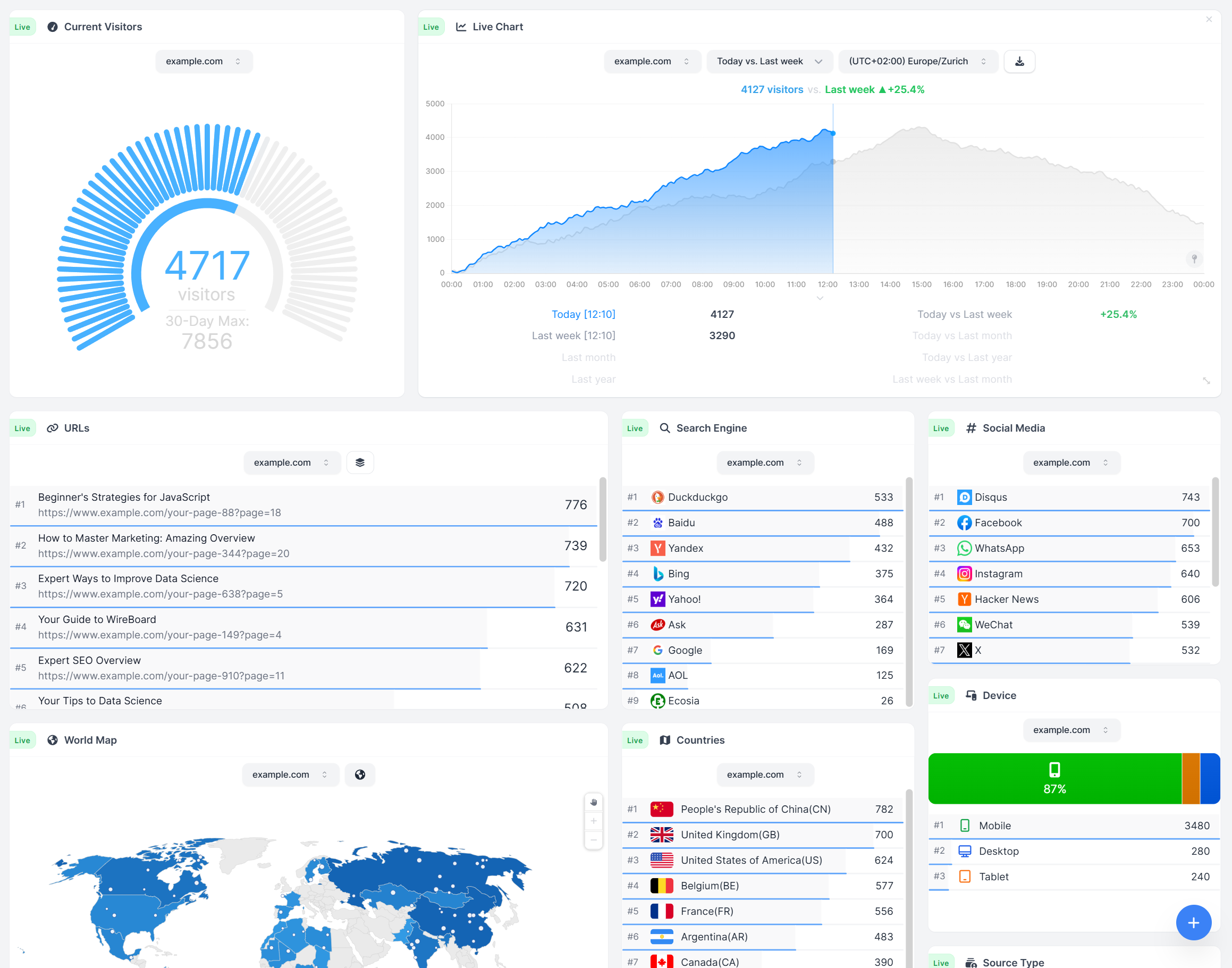
WireBoard streams. The live visitor counter, the world map, the referrer panel, the UTM campaign feed, the device and browser splits, the event feed, the funnel, the user journey: they all update the moment something happens. The "current visitors" count covers a full day of concurrent activity, not a 5-minute or 30-minute window. If a tweet lands, you see it land.
Why does this matter? It depends on what you do. If you check analytics once a week before a meeting, you don't need streaming. If you're Barry Schwartz watching SERP volatility on a Google update day, or you're running a flash sale, or you're shipping a launch, the difference between "30 seconds ago" and "right now" stops being academic. That's why we built WireBoard's pipeline in-house: third-party ingestion services can't deliver true streaming, and we wanted streaming to be the floor, not a premium feature.
Fork two: one fixed dashboard, or sixty widgets you arrange yourself?
Plausible offers one dashboard per site, fixed layout. Every Plausible dashboard looks the same. That's a feature: anyone who's seen one can read another in 30 seconds. There's nothing to misconfigure.
WireBoard ships with 60+ widgets and drag-and-drop dashboards, but you don't start from a blank canvas. Sign up and you land on a fully populated dashboard built from a sensible default template, ready to read on day one. From there, you can keep it as is, or you can build additional dashboards (a live operations board for monitoring, a weekly review board for stakeholders, a client-facing board for customer demos), pick a different theme, drop in a world map next to a live event feed and a UTM funnel, and arrange the layout the way you actually work. Multiple dashboards per site. Three themes. Templates as a starting point, not a ceiling.
Trade-off as it actually stands: both tools onboard in roughly the same time. Plausible's ceiling is its default. WireBoard's default is the floor.
The deeper version of this fork: who owns the layout, the tool or you? Plausible answers "the tool, on your behalf." WireBoard hands you a working dashboard and says "and here are the keys, if you ever want them."
Fork three: open source, or in-house pipeline?
Plausible's Community Edition is AGPL-3.0 licensed and self-hostable. You can pull it from GitHub, run it on your own server, audit the code, and customize it. If your security or sovereignty requirements demand "the software runs on servers we operate," Plausible wins outright.
Worth knowing: the self-hosted edition is updated twice a year, while cloud is continuous, and a few features (revenue tracking, advanced funnels, some integrations) are gated to paid cloud tiers. Self-hosting trades release cadence for control.
WireBoard is not open source. It's a closed-source managed service. We made that call because we wanted to own the entire pipeline (collection, processing, storage, dashboards) and ship streaming-real-time as the default. That meant no third-party ingestion services, no external pipelines, and a tighter feedback loop on infrastructure. It also means you can't self-host us, and you have to trust SwissOps Ltd. as your operator. If self-hosting is a non-negotiable for you, Plausible's Community Edition is the obvious fit.
Fork four: cookieless-only, or cookies on by default with cookieless available?
This is the fork most reviews get backwards.
Plausible runs without cookies, full stop. There's no toggle. The marketing line is "no consent banner needed."
WireBoard runs cookies on by default for the most accurate tracking (returning visitors, journeys, engagement depth). One switch flips the whole site to cookieless mode under Legitimate Interest, no consent banner needed.
In capability terms, WireBoard's approach is the strict superset. You can run cookieless if you want to, or you can keep cookies on for the accuracy gains. Plausible only offers the cookieless mode. The only reason to prefer Plausible's "no toggle" approach is if you want the legal narrative simplified to "we use a tool that has no cookie option, the conversation ends there." That's a real reason for some legal teams. It's not a capability advantage.
What Plausible does better than WireBoard today
There are concrete things Plausible offers that WireBoard does not. If any of these are critical for your team, pick Plausible. They're a good company.
Open source self-hosting. Already covered. Real, structural advantage.
Slack-native reporting and configurable traffic-spike alerts. Plausible can send weekly and monthly reports plus traffic-spike notifications into a Slack channel. WireBoard ships scheduled email reports today, but no first-party Slack integration and no configurable spike alerts. Both are on the roadmap. Today, Plausible has them and we don't.
Saved named segments. Plausible lets you save named audience segments (a combination of filters) for one-click access. WireBoard offers fast cross-filter slicing via tags but doesn't currently expose a "save this filter combo as a named segment" workflow.
Strict-order funnels. Plausible offers two funnel modes: sequential and strict-order. WireBoard's funnels are flexible by design. If you specifically need a funnel that fails when a visitor takes any detour, that's Plausible.
Brand maturity. Plausible has been in market since 2018, has a large GitHub footprint, weekly public changelog updates, and a community forum with years of accumulated answers. WireBoard is younger. If "size of the public community" is a tiebreaker, Plausible wins.
That's five concrete advantages. Not marketing-line advantages. Real ones.
What WireBoard offers that Plausible doesn't
The inverse list, kept to capability gaps visible in both products' public documentation:
Streaming live widgets, not polling. Not just a "current visitors" number. The live visitor counter, world map, referrers, UTM campaigns, device and browser splits, event feed, funnels and user journey all update the moment something happens. Historical reports work on stored data the way any analytics tool's history view does.
Multi-site live aggregation in a single widget. The same widget that shows traffic for one site can show aggregated live traffic for any selection of your sites. For agencies and multi-brand operators, this is the single biggest functional gap between the two tools.
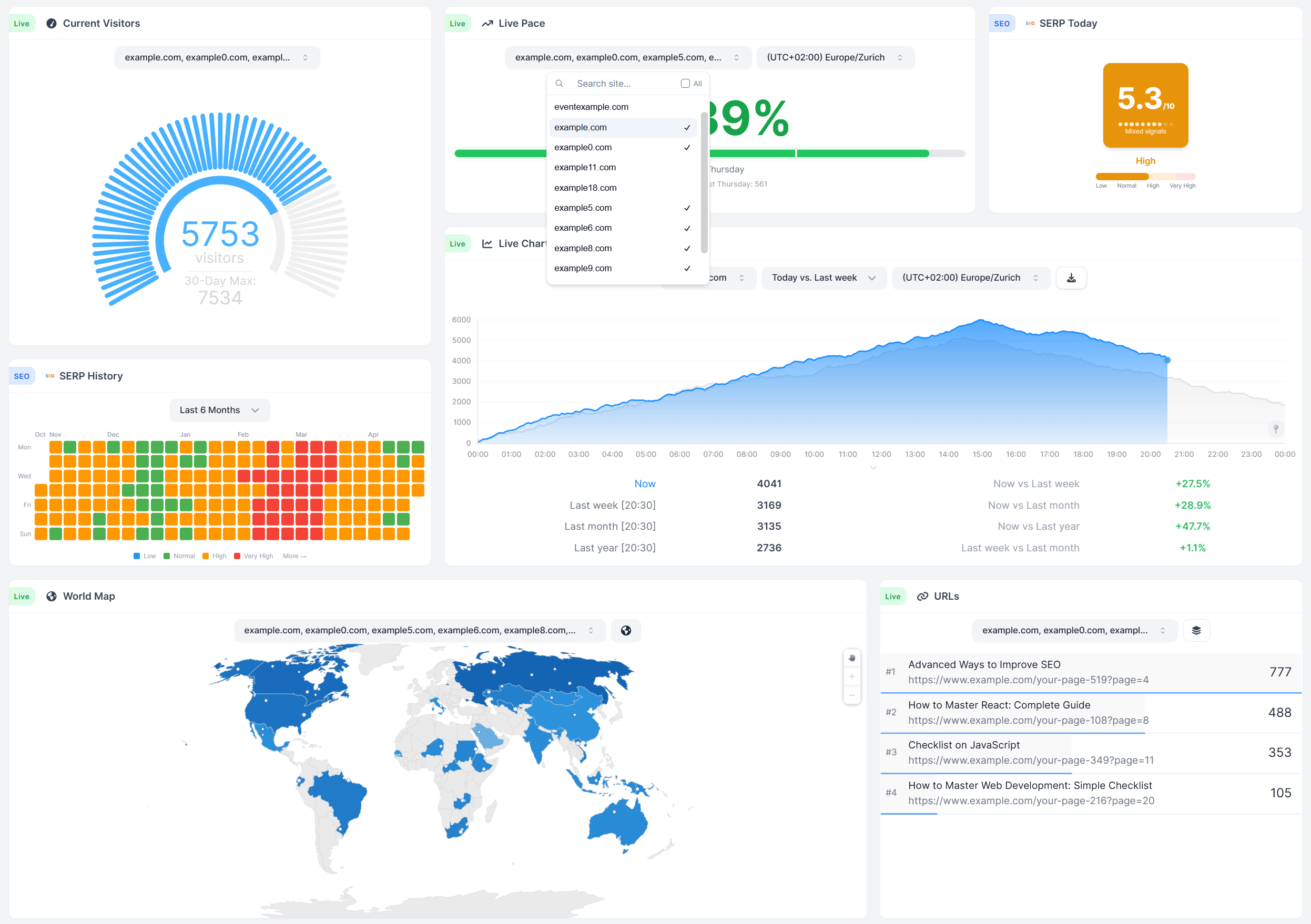
SERP Volatility live dashboard, Google Updates timeline, holiday annotation overlay. Plausible doesn't ship an SEO suite. WireBoard does. On algorithm-panic days, it's the difference between a 30-second briefing and an hour of guessing.
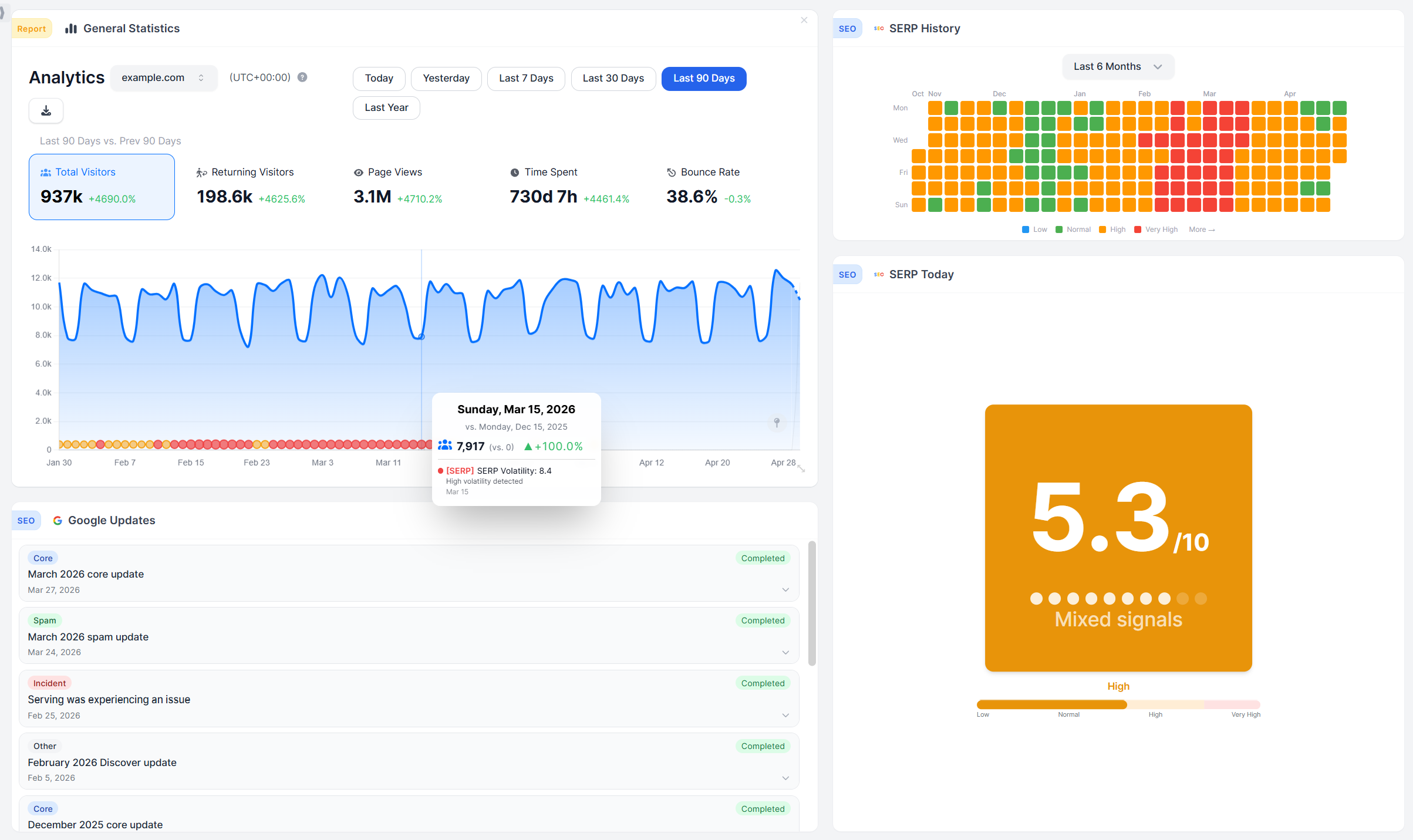
60+ drag-and-drop widgets, multiple dashboards per site, three themes. Plausible is one dashboard, fixed.
Annotations layer on every time-axis chart. Four built-in layers (My Events, Google Updates, SERP Volatility, Public Holidays) plus per-user notes. Plausible has none.
Streamer Mode and screenshot capture. For client demos, screen sharing, and screenshots without revealing your domains and URLs.
Per-graph or per-site timezone. Plausible uses one timezone per dashboard.
Goals with revenue per event property value. Track revenue by plan tier, by country, by source, in real time.
Read-only public API on every plan, including Free. WireBoard exposes a public API at https://api.wireboard.io with two surfaces: a REST API (account, sites, aggregate reports, time-series, breakdowns, URL explorer, custom events) available on every plan including the permanent Free Plan, and a Live API over Server-Sent Events streaming 20 categories of visitor activity in real time, available on every paid plan. Plausible ships its public API on the Business plan ($19+/mo) only. WireBoard also ships official SDKs for JavaScript/TypeScript/Node (@wireboard/api) and Python (wireboard-api), plus an official MCP server (@wireboard/mcp) that lets Claude, Cursor, or any LLM agent query your analytics inline. Plausible has neither official SDKs nor an MCP server. See the WireBoard API overview for the full reference.
Choosing WireBoard as a Plausible alternative
Most people who type "Plausible alternative" into Google have been working with Plausible for a while and want a tool that can do more. Start with the live data: WireBoard streams the visitor counter, the world map, the referrer panel, and the event feed the moment a hit lands. Open the dashboard during a launch and you watch traffic arrive as it happens. Around that streaming core, WireBoard ships sixty-plus drag-and-drop widgets, multiple boards per site, three themes, and a populated default template the minute you sign up.
Running a portfolio? One live widget rolls every site into one streaming view. Marking deploys, campaigns, or Google updates on a chart? Four annotation layers paint your events on every time-axis chart. Building real-time funnels? They're on every plan, no Business-tier upgrade required.
Every paid feature is unlocked on every paid tier, and the permanent Free Plan covers 50,000 pageviews on two sites and three boards. If any of that is you, WireBoard is the Plausible alternative built for the way you already work.
Should you trust this comparison?
Fair question. Here's where I'm coming from:
I run WireBoard. I've used Plausible, talked to people who chose it over us, and read their docs and changelog more times than is healthy. This is the comparison I wish existed every time a prospect emails me asking how the two products actually differ. Where Plausible is the better fit, I'll tell you. Where WireBoard is the better fit, I'll tell you that too, and I'll back it up.
Two more things to weigh:
Verifiability. Every claim about Plausible is grounded in their public documentation, pricing pages, or changelog, all linked at the bottom of this post. Every claim about WireBoard is grounded in shipping product. Where something is on our roadmap and not yet live, I've said so out loud (Slack reporting, traffic-spike alerts).
Customer signal. WireBoard is used by people who care about real-time traffic data, including Barry Schwartz of Search Engine Roundtable (who covers Google algorithm updates daily), Robert Farrington of The College Investor, and Jon James of TeamGreet. They didn't pick us because they couldn't find Plausible. They picked us for specific reasons. If your workload looks like theirs, that signal is worth more than my opinion.
How the pricing actually plays out
Prices below were recorded from each company's published pricing page in May 2026. Both Plausible and WireBoard adjust pricing periodically. Before making a buying decision, verify current rates on the Plausible pricing page and the WireBoard pricing page.
The two pricing models reflect the two philosophies. Plausible scales price by pageview volume and gates features behind tiers. WireBoard scales price by quotas (pageviews, sites, dashboards, seats, history) and includes every feature on every plan.
Plausible's tiers
Plausible has four plans. The price within each plan rises with monthly pageview volume; the entry point for 1M pageviews lands roughly between $69 and $139/month depending on the plan.
| Plausible plan | Entry price | Pageviews/mo | Sites | Team seats | What it adds |
|---|---|---|---|---|---|
| Starter | from $9/mo | 10,000 | 1 | Solo (1) | Single site, solo use |
| Growth | from $14/mo | 10,000 | up to 3 | up to 3 | Multiple sites, team members, shared dashboards, shared segments |
| Business | from $19/mo | 10,000 | up to 10 | up to 10 | Funnels, revenue tracking, custom properties, ecommerce, public API, Looker Studio |
| Enterprise | Custom | Custom | Custom | Custom | SSO, Sites API, managed proxy, raw data exports, custom retention |
There's a 30-day free trial, no credit card. There is no permanent free tier.
WireBoard's tiers
WireBoard ships nine plans, starting at $0 forever. Yearly billing saves about 17% (two months free). Every paid tier above includes every feature, every dashboard, every integration.
| WireBoard plan | Monthly | Pageviews/mo | Sites | Dashboards | Team seats | History |
|---|---|---|---|---|---|---|
| Free Plan | $0 | 50,000 | 2 | 3 | 1 | 30 days |
| Micro | $9 | 100,000 | 50 | 100 | 3 | 3 years |
| Small | $19 | 250,000 | 50 | 100 | 5 | 3 years |
| Medium | $24 | 500,000 | 50 | 100 | 10 | 3 years |
| Large | $49 | 1,000,000 | 50 | 100 | 15 | 3 years |
| Extra Large | $99 | 3,000,000 | 50 | 100 | 20 | 3 years |
| Pro | $199 | 6,000,000 | 50 | 100 | 30 | 3 years |
| Pro Plus | $399 | 12,000,000 | 100 | 200 | 50 | 3 years |
| Enterprise | Custom | Custom | Unlimited | Unlimited | Unlimited | Custom |
Same volume, side by side: WireBoard is 30% to 100% cheaper
The difference shows up clearly at every pageview tier.
| Pageviews/month | WireBoard | Plausible Starter | Plausible Business (funnels, revenue, public API) | You save with WireBoard |
|---|---|---|---|---|
| 10,000 | Free | $9/mo | $19/mo | $9 to $19/mo |
| 100,000 | $9/mo (Micro) | $19/mo | ~$29/mo | 53% to 69% |
| 1,000,000 | $49/mo (Large) | $69/mo | ~$139/mo | 29% to 65% |
| 6,000,000 | $199/mo (Pro) | ~$299/mo (~5M tier) | Higher | ~33% and up |
Plausible numbers are pulled from their published plans. The middle column compares WireBoard with Plausible's cheapest tier. The right column is fairer for most buyers: it compares WireBoard with the Plausible plan that actually includes funnels, revenue tracking, custom property depth, and the public API, since those are the features most people who shortlist these tools want.
Three differences that actually move the buying decision
- WireBoard is materially cheaper at every comparable volume. Same pageview count, lower price. At 1M pageviews with the features most teams actually want (funnels and revenue), the difference is $49 vs ~$139 per month. Over a year, that's $1,080 saved. Over three years, $3,240.
- Permanent free plan, every feature included. WireBoard ships a free tier with 50,000 pageviews, 2 sites, 3 dashboards, no credit card, and no expiry. Plausible has a 30-day trial, then you pay or you stop.
- No feature gating, ever. Funnels, revenue tracking, custom events with properties, segments, ecommerce reports, SEO suite, multi-site aggregation, embed tokens, Streamer Mode: every one of them is on every WireBoard tier, including free. With Plausible, several of those (funnels, revenue tracking, custom properties, ecommerce, public API) are gated to the Business plan, which roughly doubles your monthly cost at every pageview tier. SSO sits even higher, on Enterprise.
Plausible is asking you to grow into the product, paying more as you need more. WireBoard hands you the whole product on day one and charges less for the same volume.
Still not sure? Install both side by side.
Reading is the slow way to make this call. Installing both is the fast way.
Plausible has a 30-day trial. WireBoard's free plan never expires (no card, every feature). Add the script to one real site, send some traffic, and watch what happens on each dashboard.
You'll see the difference quickly. Specifically:
- Open both dashboards on a single screen. Send a real visit (or have a friend send one). Time how fast each one shows it. You'll see the streaming-vs-polling difference in seconds.
- Look at how each one handles a busy moment. Run a small ad, share a link, or just wait for organic traffic. Note which dashboard you'd rather watch during a launch.
- Try to answer one question that actually matters to your work. "Which UTM campaign converted yesterday?" "What's the bounce rate on my new landing page by country?" "Did my deploy break anything?" Whichever tool gets you the answer faster wins on your specific job.
The four forks above stop being abstract once you've put both dashboards side by side.
Pros and cons at a glance
| WireBoard | Plausible | |
|---|---|---|
| + | ✅ True real-time, streaming live ✅ 60+ widgets, fully customizable ✅ Multi-site live in one view ✅ SERP volatility + Google update tracking ✅ Public REST API on every plan + Live SSE on paid ✅ Official JS, Python SDKs + MCP server for LLMs ✅ Every feature on every plan, even free |
✅ Open source, self-hostable ✅ Slack-native reporting |
| − | ❌ No self-hosting ❌ No first-party Slack reporting |
❌ 30-second polling, not streaming ❌ One fixed dashboard per site ❌ No SERP / Google-update tracking ❌ Public API gated to Business plan ❌ Feature-gated tiers (funnels, revenue) ❌ No annotations on charts |
The bottom line
Plausible is the better pick in two specific cases: open-source self-hosting is non-negotiable, or first-party Slack-native reporting and traffic-spike alerts are baked into your workflow already.
For everyone else, WireBoard is the answer. Live traffic streamed the moment a visitor lands. Sixty-plus drag-and-drop widgets and multiple dashboards per site. Live multi-site aggregation in a single widget. SERP volatility and Google algorithm-update signals on the same dashboard as your traffic. Every feature on every paid tier, permanent Free Plan included. Funnels, revenue tracking, custom event properties: all included, no tier to unlock.
Start tracking for free with WireBoard. 50,000 pageviews per month, 2 websites, 3 dashboards, every feature included. No credit card. No trial period. No catch.
Sources
WireBoard
- WireBoard homepage
- WireBoard pricing
- WireBoard features
- SERP volatility live tool
- Google Core and Spam Updates timeline
- WireBoard product timeline and changelog
- WireBoard privacy policy
- WireBoard documentation
- WireBoard API overview
- WireBoard JavaScript SDK (
@wireboard/api) - WireBoard Python SDK (
wireboard-api) - WireBoard MCP server (
@wireboard/mcp)
Plausible (where the claims about their product are grounded)
- Plausible subscription plans
- Plausible realtime dashboard documentation
- Plausible Community Edition on GitHub
EU data protection and infrastructure